How to conduct a training needs analysis: a step-by-step guide for HR teams

Your company has a training budget the law requires you to have. The problem is not the money. It is knowing what to spend it on.
Every company with employees in Spain contributes to vocational training through Social Security. That contribution generates a subsidised training credit managed through FUNDAE (Fundación Estatal para la Formación en el Empleo, Spain's national body for workplace training), calculated on prior-year contributions with a coefficient that varies by company size. That credit can be recovered when you fund accredited training. It belongs to your company by law. And yet most SMEs spend it on generic catalogues: Excel courses, communication training, content platform subscriptions, with no prior analysis indicating whether that training actually addresses the real competency gaps in their organisation. The credit expires. The competency problem remains.
The training needs analysis is exactly that tool. It tells you, with data you can defend in front of your leadership, where the competency gaps in your workforce are, which are most urgent for the company's strategy, and, in the Spanish context, how to ensure your FUNDAE credit works for the business, not for a training catalogue.
According to Gartner (2024–2025), only 8% of organisations have reliable data on the competencies their workforce has and which are actually useful to the business. That means 92% of companies approaching a training needs analysis are building on a more fragile foundation than they realise: self-assessments that reflect how confident people feel, not what they can actually do; manager ratings that favour whoever had the most visibility in the last performance review; and annual surveys that are already out of date before anyone acts on them.
This guide explains how to conduct a training needs analysis in a way that produces results you can present to your leadership: results anchored in reliable data, with a prioritised list of gaps and a clear recommendation on what to do next.
Ask most HR Managers how they currently track competencies in their organisation. The honest answer is usually: "We don't, really." What exists is a patchwork: job descriptions from when the person was hired, some training completion records, and what the manager remembers from the last performance review. The turning point comes when a concrete question arises: "Of the employees who completed that training, how many are actually using that competency in their work today?" The silence that follows says everything. They have completion data. They do not have application data. That is the shift that changes everything: what most companies call a "competency inventory" is actually a course registration log. It tells you who attended. It does not tell you who can do the job. According to research published in Harvard Business Review and studies of organisational learning, 88% of employees do not apply at work what they learn in training, which means most "competency data" in organisations is measuring something radically different from the actual capability of the workforce.

What is a training needs analysis?
A training needs analysis is the process of identifying the difference between the competencies your workforce currently has and those your organisation needs to achieve its strategic objectives. The output is not a number: it is a prioritised competency gap map ordered by business impact and urgency. A well-executed training needs analysis answers three questions: what competencies does our strategy require?, what competencies do we currently have (measured rigorously)?, and what is the distance between those two states?
In Spain, this process is often referred to as detección de necesidades de formación (DNF, training needs identification): the most widely used operational term among training and development departments and the one used in FUNDAE credit planning. When a company draws up its Plan de Formación de Empresa (Company Training Plan, mandatory for companies with a works council), the DNF is the diagnostic document that feeds into it.
The word "gap" can be misleading, because it implies a single deficit to close. In practice, a useful training needs analysis produces a structured picture across multiple competency domains, weighted by the urgency with which each gap threatens business priorities. The most useful question is not "what are we missing?" but: which gaps can we not afford to leave open? Not all gaps are equal. A well-conducted training needs analysis helps make that distinction.
Without that prioritisation, the output becomes an endless list that nobody implements.
What is a competency assessment? A practical guide for HR
Why a training needs analysis is urgent in 2026
If your CEO or general manager is asking about workforce capability this year in a way they weren't two or three years ago, there are solid reasons for it. And if you are the person running HR on your own (or with one support role) in a company of 50 to 200 employees, you are probably already asking yourself the question, without anyone needing to prompt you.
The pace of skills change has accelerated significantly. According to the World Economic Forum's Future of Jobs 2025 report, employers expect 39% of workers' core skills to change before 2030, and skills gaps in the labour market are the primary obstacle to business transformation, cited by 63% of employers surveyed. Organisations without a current picture of their workforce's competencies cannot plan or prioritise training effectively.
The economic consequences are substantial. According to IDC (reported by Workera and CIO Dive, 2024), more than 90% of global companies expect to face critical skills shortages before 2026, with cumulative losses estimated at $5.5 trillion as a result of delayed projects, quality failures, lost revenue and deteriorating competitiveness. The skills gap is no longer an HR problem: it is a business risk that belongs on the Board's agenda.
Artificial intelligence adoption is being blocked by talent, not technology. According to McKinsey (2024–2025), nearly half of C-suite executives at global companies consider AI tool deployment to be moving too slowly. The main reason cited, above budget and technology availability, is the talent skills gap, mentioned by 46% of respondents. Competencies are now the bottleneck for AI investment returns.
Despite this awareness being nearly universal (McKinsey estimates 87% of companies globally are already facing a significant skills gap), only one in three says it is genuinely prepared to address it. Most are navigating blind.
In Spain, there is a very concrete reason to act now: law, money, and documentation point in the same direction.
Article 23 of the Estatuto de los Trabajadores (Workers' Statute) recognises the employee's right to training necessary to adapt to their role. The Supreme Court has reinforced the employer's obligation to provide it before invoking objective grounds for dismissal due to failure to adapt. In practical terms: if a worker cannot adapt to changes in their role and the company cannot demonstrate it offered training to support that, the dismissal is in a weak position before a tribunal. The training needs analysis is the documentation that anchors that obligation, and that the company can present if needed.
Companies with more than 50 employees (and therefore with a works council or staff delegates) must consult or negotiate the Company Training Plan with workers' legal representatives, as established by Law 30/2015 of the SEPE. The training needs analysis is the prior diagnostic that makes that plan defensible in front of employee representatives.
And then there is the money. Companies with employees in Spain contribute to vocational training through Social Security. That quota generates an annual FUNDAE credit, calculated on prior-year contributions with a coefficient that varies by company size, which can be used to subsidise accredited training. The credit exists even if nobody claims it.
The real flow is this: the documented TNA feeds the Company Training Plan → communicated or negotiated with workers' representatives (where applicable) → accredited training actions are executed → the Participation Report is generated → the company deducts the training cost from its TC1 the following month. Without the TNA as the first step, the training you buy is arbitrary. With it, it is traceable, subsidisable and legally documented.
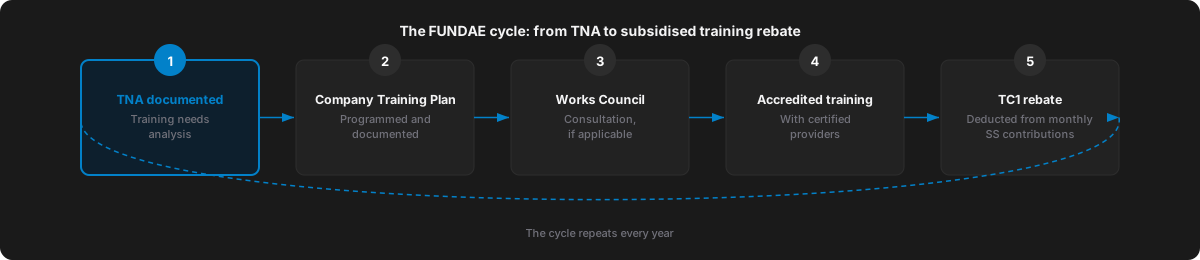
That combination of strategic pressure, legal obligation and budget already available is why knowing how to conduct a training needs analysis has become a priority for any HR Manager or Director in Spain, particularly in SMEs where there is no dedicated learning and development function.
Before you start: 3 factors that will determine success
Before launching any survey or opening a spreadsheet, you need to resolve three foundational questions. Skipping this stage is the most common reason why training needs analyses produce results that are never used.
1. Business strategy alignment before everything else
A training needs analysis without a clear business question behind it is simply a competency inventory. It produces a picture of what your organisation has and lacks, but without a reference frame for what matters, that picture is useless.
The question that focuses everything: What does this company need to achieve in the next 12 to 24 months, and what does that require from our people?
That question must come from your business leaders, not from HR alone. Josh Bersin's research on dynamic skills development (March 2025) is direct on this: "Skills needs are changing faster than ever, so organisations must continuously assess what skills they have and need, and HR and the business must drive this together, as HR alone may not always know what is required."
Talk to your CEO, to the heads of business areas, to the leaders of product or operations before you design a single survey question. Ask them what the company needs to be able to do in the next two years that it cannot do reliably today. Their answers are your scope.
If you start without that alignment, you will produce results that HR finds interesting but leadership ignores.
2. Decide exactly what you are measuring
This seems like a procedural question but it causes real problems in practice. Are you measuring:
- Competency gaps by role: does a specific position have the competencies the business needs from that role?
- Individual domain gaps: does a specific person have the competencies needed for their current or next role?
- Organisational capability gaps: does the company as a whole have sufficient depth in a competency domain to execute its strategy?
These are different measurements that require different data collection approaches and produce different outputs. Trying to answer all three simultaneously with a single survey (a very common mistake) can produce data that answers none of them with sufficient precision to act on.
For most HR Managers conducting this process for the first time, starting with competency gaps by role is the most manageable entry point. It connects directly to workforce planning, is easier to scope, and produces results that line managers can use.
Competency map: how to build one step by step
3. Assume your current data is inaccurate
This is the uncomfortable part. Most HR teams, when starting a training needs analysis, assume their existing data (LMS completion records, competency ratings from performance reviews, the self-assessment from last year's development planning cycle) provides a reasonable baseline. It usually does not.
Self-assessments are systematically inaccurate. Employees overrate their capabilities when they want to appear qualified for a growth opportunity. They underrate them when they lack confidence or when a question is framed in a way that generates uncertainty. Neither version reflects their actual capability.
Manager ratings can add an additional layer of inconsistency. Visibility matters as much as performance in how managers assess their employees: quieter but high-capability team members may receive lower ratings than vocal, visible ones, regardless of their actual differences in capability.
The result: most organisations conducting a training needs analysis are producing a picture of their workforce's confidence and visibility, not their actual competencies. It is a very costly mistake to make at scale.
If you already run an annual performance review: The training needs analysis does not need to be a new process added to your calendar. The data you already have (performance ratings, objectives met/unmet by area, completed training records) is the starting point. Before designing any new survey, audit what information you already have and what is missing. Most HR teams discover they have more data than they thought, but organised in a way that does not allow comparison across roles or gap measurement. The training needs analysis is partly a structured reordering of data that probably already exists in your organisation.
The 5-step framework for a training needs analysis
Each step builds on the previous one. Do not rush Step 2. Most analyses that fail do so not because the framework is wrong, but because the data entering Step 3 was not reliable enough to act on.
1Define the competencies your organisation truly needs
What this step produces: A prioritised list of 10–20 critical competency domains linked directly to business objectives.
Start from the business, not from your competency map.
- Gather the business priorities for the next 12 to 24 months. If you have a strategy document or annual operating plan, start there.
- Schedule short conversations (30 minutes is enough) with decision-makers in your company: your general manager or CEO and 2–3 area heads or department heads. In an SME of 50 to 150 people, you do not need a broad committee: three well-run conversations give you the input you need. Use a consistent framing: "What are the 3 things this function needs to be able to do in the next 18 months that it cannot do reliably today?"
- Translate the answers into competency domains, not job profiles. "We need to launch in Germany in Q3" translates into domains like international commercial negotiation, regulatory knowledge and language capability, not "we need more salespeople."
- Consolidate the results into a prioritised list of competency domains. Group by strategic priority and assign a weight: critical (blocks the strategy), important (limits performance) or emerging (relevant for the future).
- Validate the list with business stakeholders before continuing. This step secures business buy-in and reduces the risk of building a framework that HR manages but the business ignores.
Your output: a prioritised list of 10–20 critical competency domains, each linked to a specific strategic objective, with a named business owner for each domain.
Running HR solo in a company of fewer than 150 people? 10–20 domains is too many to start. Pick 5: the ones directly connected to the most urgent business priority of the year. This is not less rigorous — it is more defensible because you will actually execute it. A well-executed 5-domain analysis produces more impact than a 20-domain one that nobody finishes.
The most common error in this phase is defining competencies at the wrong level of abstraction. HR teams tend to use broad competency categories ("Leadership", "Communication", "Problem Solving") because that is how most competency frameworks are structured. But development happens at the behaviour level, not the category level. "Data analysis" as a competency domain is nearly useless without role context: for a sales professional it means reading a CRM dashboard; for a data engineer it means writing optimised SQL queries. The same label maps to fundamentally different capabilities, which means you cannot measure, prioritise or develop it until you have made it role-specific.
The second most common error is scoping the project without the managers who actually know which competencies matter on the ground. When HR defines the competency framework in isolation, two things happen: the resulting competencies look coherent on paper but do not map to real work, and managers have no ownership of the process, which means participation in the assessment phase drops before you have collected any data.
Competency map: how to build one step by step
2Get a reliable picture of the competencies you already have (and do it right)
What this step produces: A competency inventory with proficiency levels and reliability scores, not binary checkboxes.
This is where most analyses fail.
The problem with relying on a single data source (especially self-assessment alone) is that you end up measuring something different from what you think you are measuring. To get a picture of actual competencies that is reliable enough to act on, you need at least three sources:
- Self-assessment layer: Ask employees to rate their proficiency level in each competency domain using a defined scale (e.g. 1–4: Basic / Operational / Proficient / Expert). Provide behavioural examples for each level so that ratings are calibrated, not arbitrary.
- Manager validation layer: Ask direct managers to independently rate their employees on the same domains using the same scale. Do not show employees' self-assessments to managers before they complete theirs. This prevents anchoring bias.
- Objective performance data layer: Where available, cross-reference with tangible performance evidence: project outcomes, certifications, technical test scores, performance review comments, internal mobility records. This third layer reduces the impact of both self-assessment inaccuracy and inconsistency in manager ratings.
- Calculate a reliability score for each rating. When self-assessment and manager rating diverge by more than one level, flag the rating as "low reliability" and treat it as a gap, not a confirmed capability.
As AI-powered competency assessment tools become mainstream (Gartner notes that 9 in 10 organisations have already adopted or are planning to adopt competency-based talent management), a fourth emerging approach is worth knowing: AI-assisted competency inference, which extracts signals from work data (employment history, project participation, outputs) to infer competencies without requiring self-assessment. It does not replace the three-source approach, but can help fill gaps, especially for employees with low self-awareness or limited visibility to management.
Your output: a competency inventory that shows proficiency levels (not just checkboxes) and indicates where your confidence in the data is higher or lower.
A note on manager availability: In manufacturing or production companies, area managers are on the floor. In service SMEs, they are with clients. If you cannot guarantee that managers complete validation independently, run the self-assessment first and add the manager layer in the next quarterly round. A single-source analysis that is well-executed and scoped is more useful than a three-source one that nobody completes. Being honest about data reliability (marking "low reliability" where you only have one source) is what makes the analysis defensible.
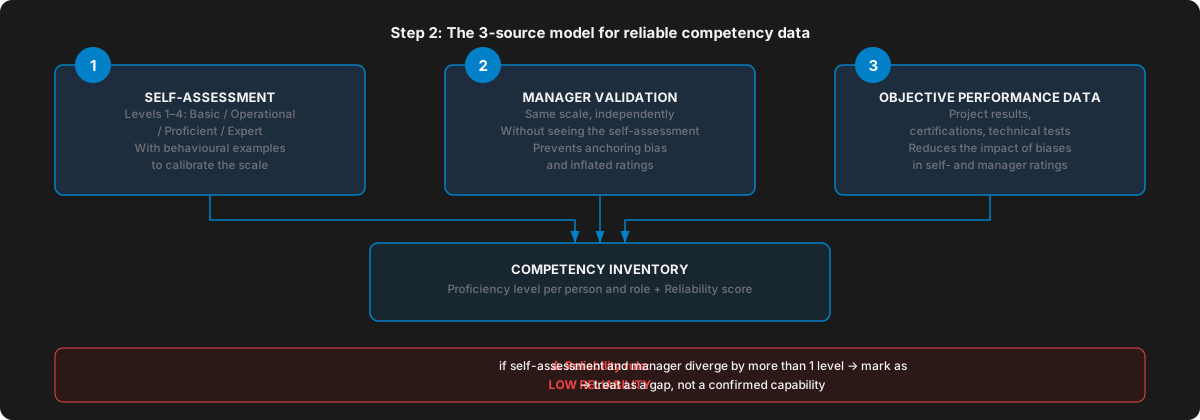
In practice, this phase fails in predictable ways. The most common culprit, responsible for approximately 60% of data collection failures, is friction. Traditional competency assessments ask employees to fill in long forms or complete extensive tests. Completion rates drop sharply when assessments exceed 25 minutes; anything longer almost guarantees an incomplete picture. The second most common failure is self-assessment bias, affecting roughly a quarter of cases: employees with limited capability tend to overestimate themselves because they do not know what they do not know, while high performers underrate themselves by comparing against experts. The result is a self-reported competency inventory with a reliability margin of ±30–40%, which is worse than useless for selection or L&D investment decisions. Manager non-participation accounts for most remaining failures: they are busy, they procrastinate, and many give inflated ratings to avoid difficult conversations with their teams. The structural conclusion is the same in all three cases: data collection fails when treated as a separate project (something employees and managers must do on top of their normal work) rather than as a natural output of how learning and performance already happen.
Want to start your gap analysis with the competency that is changing fastest? Skillia's free AI competency assessment takes less than 25 minutes and generates a report showing your level in the most in-demand AI competencies, with a personalised development plan. No long forms, no subjective self-assessments. It is exactly the kind of objective data this step needs. Assess your AI competencies →
3Map the gap and prioritise what matters
What this step produces: A prioritised gap map, not an exhaustive list of every missing competency.
At this point you have two pictures: what the business needs (Step 1) and what you currently have (Step 2). The gap is the difference between the two.
But not all gaps are equal, and you cannot address them all at once. A simple 2×2 matrix cuts through the noise:
- Plot each competency domain on two axes: Business impact (high/low: how much does closing this gap improve strategy execution?) and Gap size (large/small: how far is the current workforce from the required proficiency level?).
- Categorise gaps into four zones:
- Critical gaps (high impact, large gap): act immediately — they block the strategy
- Quick wins (high impact, small gap): close these first — high return relative to effort
- Emerging gaps (low impact, large gap): develop over time
- Low priority (low impact, small gap): deprioritise — do not invest in these now
- Produce a ranked list of the 3–5 priority gaps to address in the next 12 months. Everything else goes to a backlog.
- Present this map to business stakeholders before moving to Step 4. Their validation converts the training needs analysis from an HR deliverable into a business action plan.
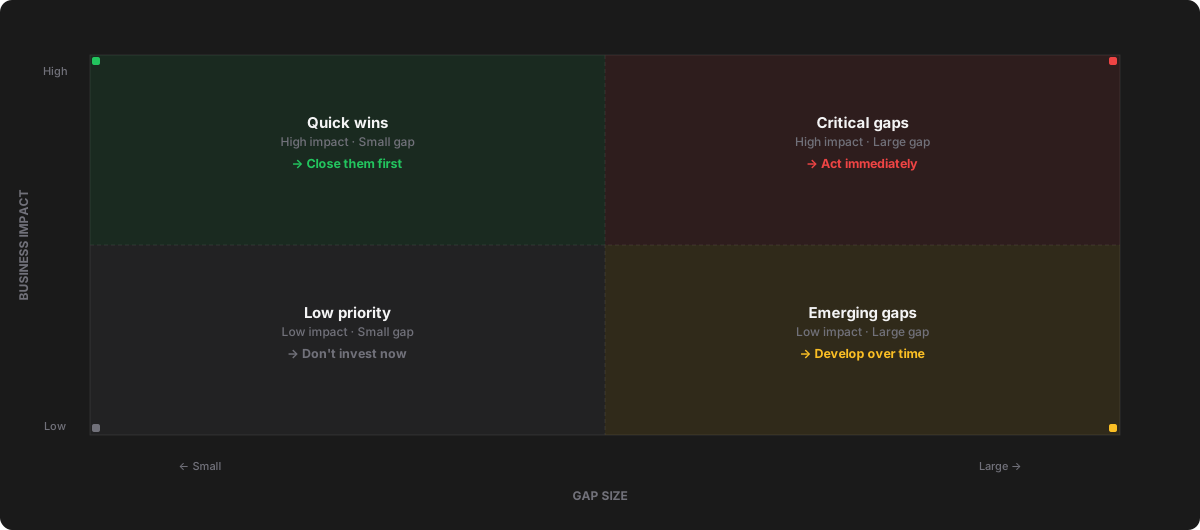
The most useful output of this step is a prioritised gap map: a structured view of which gaps are most urgent and most consequential, not a list of every competency that is missing.
4Decide whether to build, buy or borrow
What this step produces: An action plan per critical gap category, with decision criteria and named owners.
For each priority gap, you have three options, and choosing the right one matters more than the analysis itself:
Build internally: Train the people you already have. This is the right option when the competency can be acquired through training or experience in a realistic timeframe, when you have people to develop, and when retaining that capability internally matters to the business. Research indicates companies get around €5 return for every €1 invested in training, but only when that investment responds to an identified need, which is exactly what your analysis has produced. In Spain, this option is especially attractive if your company has FUNDAE subsidised training credit available, since training designed from the training needs analysis can be financed wholly or partially with that credit, significantly improving the ROI of the decision to build internally.
Buy externally: Select talent from the market. This is the right option when the gap is too deep to close internally within the required timeframe, or when you need senior-level expertise that cannot be developed from scratch. Competency-targeted hires, selected precisely for the capabilities you need, tend to integrate more effectively than those based primarily on credentials.
Borrow temporarily: Bring in capability through contracts, freelancers or partners. This is the right option when the gap is temporary, when the required depth is bounded, when speed of access matters more than long-term internal capability, or when your budget cannot support a permanent hire for that domain. Bear in mind: when the external resource leaves, the capability may leave with them.
The three options are not equal. They are cascading constraints. This decision tree produces a more reliable answer than choosing intuitively:
How much time do you have to close the gap?
- Less than 6 months → Building internally is normally not viable in this timeframe. Evaluate buying or borrowing.
- Between 6 and 18 months → Building internally is possible if you have suitable candidates and a realistic training plan.
- More than 18 months → Any option is viable; cost and retention determine which.
Does this competency need to stay inside your organisation long-term?
- Yes (it is differentiating, strategic, or involves sensitive information) → Rule out borrowing. The capability leaves when the external resource does.
- No (it is support, one-off or temporary) → Borrowing may be the most cost-efficient option.
Does your budget support a permanent hire?
- Yes → Buy if there is no time to build; build if there is time and internal candidates are identified.
- No → Build if there is time; borrow if there is not; combine if you have FUNDAE credit available for the training component.
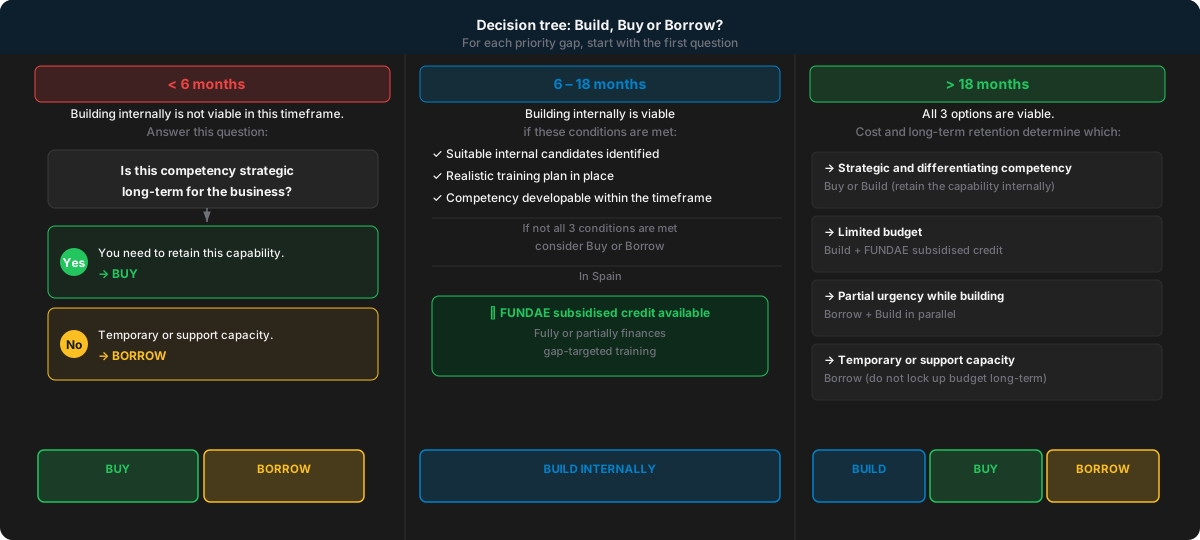
The output of this decision tree for each priority gap is your Step 4 action plan.
According to AIHR research on the HR Competency Framework 2025, 66% of HR professionals say they can identify the competencies their organisation needs to grow, but only 48% know how to actually acquire them. This step is where that gap is closed.
The most common error in this phase is making the structural decision before having the data to justify it. The pattern is familiar in companies of 50 to 200 employees: the CEO or HR Manager recognises a competency problem, and the first instinct is to hire a Learning and Development Manager. That hire costs around €60,000 per year in salary, with an adaptation period of roughly six months before there is any structured output. Those six months are then spent trying to understand what competencies exist and what the business actually needs: the same diagnostic work the training needs analysis is designed to produce. The result is a highly capable person dedicating most of their time to manual planning work that does not scale and is not kept up to date. The sounder approach is to complete the analysis and prioritisation work first, then determine whether a full-time L&D hire is justified based on what the data shows.
Your output: an action plan per priority gap, with the recommended option (Build/Buy/Borrow), owner and timeframe.
5Measure progress and build a continuous measurement practice
What this step produces: A measurement cadence and a dashboard framework for ongoing competency intelligence.
This is where most HR teams lose the thread, and where the value of the analysis multiplies or evaporates.
The competency landscape is changing fast enough that an annual survey is frequently out of date before anyone acts on it. According to SHRM Talent Trends 2025, 32% of the competencies required by a typical job have already changed in the last three years, with generative AI projected to accelerate skills change across 68% of all job competencies by 2030. If you run a training needs analysis once a year and wait for results until the next annual review, you are navigating blind for long stretches.
Organisations that get the most value from their analysis treat it as the foundation of a continuous measurement practice, not a one-off deliverable. That does not mean running a full analysis every quarter. It means:
- Establish leading indicators, not just lagging ones. Metrics like skills acquisition rate (percentage of target employees showing measurable improvement), gap closure rate (percentage of critical gaps reduced per quarter) and internal mobility rate (percentage of vacancies filled internally with competency-selected candidates) indicate whether your action plan is working before final results arrive.
- Assign owners to each gap. Without a named owner and a review date, action plans become aspirational documents. Each critical gap must have one person responsible for closing it and a 90-day review in the calendar.
- Schedule structured reviews at 90 days and 6 months. At each review, update the competency inventory, re-run the prioritisation matrix, and re-score the main gaps. Treat new gaps arising from changes in business priorities as additions to the backlog, not reasons to start over.
- Move towards continuous signals over time. The long-term goal is to replace the annual survey cycle with a continuous data flow, extracting competency signals from performance systems, project assignments, learning completion and AI inference. According to Gartner (2024–2025), a key barrier to effective competency management is "the inability to collect and maintain up-to-date employee competency information," which means the frequency of data updates matters as much as data quality at any single point in time.
A reasonable starting cadence is: a full analysis for strategic alignment annually, with quarterly reviews to update the competency inventory and flag emerging gaps in your priority domains.
If you use Sage, BambooHR or another standard HRIS: Automatic competency inference is not available today for most SMEs. What you can do without specialist tools: (1) add a "Gap status" column to your analysis template and update it quarterly — that is 15 minutes per business area; (2) include 2–3 questions about the priority gaps identified in your annual performance review, turning a process you already have into a signal source; (3) use completed training records as a partial closure proxy, with the caveat that completion ≠ application. The goal is not perfection: it is having a regular signal that tells you whether the plan is working before a full year has passed.
66% of HR professionals can identify the competencies their organisation needs. Only 48% know how to actually acquire them (AIHR, 2025). The 5-step framework in this guide closes that gap. But Step 5 is what converts a one-off exercise into a durable capability.
The 5 most common mistakes in a training needs analysis
Most training needs analyses fail for the same reasons. These five failures appear repeatedly in organisations of all sizes.
1. Treating it as a one-off exercise. A training needs analysis is not a project with an end date. Organisations that do it once, produce a report, and do not revisit it for twelve months discover that half their conclusions are already out of date. Build the follow-up cadence into your way of working, not just the analysis itself.
2. Relying solely on self-assessments. The bias problem is real. Self-assessments have value: they are a necessary input, but not sufficient on their own. If you only collect self-assessment data, you are measuring confidence and self-perception, useful, but different from actual competency mastery. Add manager validation and objective data wherever you can.
3. Ignoring the contingent workforce. If your organisation uses contractors, freelancers or part-time workers to deliver a significant portion of its work (and most organisations of 100 to 500 employees do), excluding them from your analysis means you have an incomplete picture of your actual capability. This is especially relevant when mapping whether you have sufficient depth in a specific domain to execute the strategy.
4. Focusing only on technical competencies. The easiest gaps to measure (certifications, tool proficiency, domain-specific knowledge) are rarely the only gaps that matter. Judgement, communication, cross-functional collaboration, change management: these adjacent and behavioural competencies often have more impact on whether the strategy gets executed than the technical ones. Do not design your analysis in a way that automatically excludes them.
5. Running the analysis without business strategy input. If HR designs and runs the training needs analysis entirely in isolation, without active input from the business leaders responsible for strategy execution, the results will reflect HR's assumptions about what matters, not the actual business priorities. This is the primary cause of training needs analyses that never generate decisions.
What success looks like: the business case for doing it right
Organisations that invest in getting an up-to-date picture of their competencies and maintaining it over time see materially different results.
According to Deloitte's research on competency-based organisations (2024 report, based on 2022 survey data), organisations that have transitioned to competency-based talent management are 107% more effective at placing people in roles where they will perform well, 52% more innovative, and 98% more effective at retaining high performers. These are not marginal improvements: they are the kind of numbers that change Board conversations about HR's contribution.
Large organisations that have done this, Inditex, Telefónica and BBVA among them, report significantly higher internal mobility rates than companies that select primarily on experience history or qualifications.
Research also indicates that companies get €5 return for every €1 invested in training when that investment is targeted at identified gaps, compared to undifferentiated training programmes.
The path from "we did a training needs analysis" to "we are a competency-based organisation" starts with the five steps above. The difference between organisations that make that journey and those that do not is rarely about resources: it is whether they built the continuous measurement practice of Step 5 or stopped at the report.
In a pilot deployment with SMEs in Catalonia served through PIMEC, moving from manual competency tracking to a systematic approach with Skillia produced the following results. Note: this data is from a single pilot deployment, not a controlled study. It is shared as a concrete reference point, not as a guarantee of outcome.
| Metric | Before (manual) | After (Skillia) |
|---|---|---|
| Time to create a development plan per employee | 8–14 hours | ~10 minutes |
| Assessment completion rate | ~40–50% (long surveys) | ~80% (<25 min) |
| Training application rate | 5–15% (sector average) | 66% |
| HR hours per week on L&D administration | 15–20 hours | 2–3 hours (oversight only) |
The pilot data is a reference point, but the pattern holds in manual approaches regardless of the tool used: when assessment takes 8–14 hours per employee, it does not scale beyond a certain threshold. The maths stops working somewhere around 30–50 people, and the competency inventory becomes a snapshot that nobody has the bandwidth to keep up to date.
The first step in that pilot was exactly what this guide describes: an objective assessment that gave each employee their actual level, not a self-assessment. Skillia offers that assessment for free for AI competencies: in less than 25 minutes you get your level in the most in-demand AI competencies and a personalised development plan with recommended training. If you want to start where the pilot companies started, start here. Assess your AI competencies →
Training needs analysis template: what to include
A practical template contributes enormously to making your results credible and actionable. At a minimum, your training needs analysis template should capture the following for each competency domain assessed:
| Field | What to record |
|---|---|
| Role / Function | Which position or team this row applies to |
| Competency domain | The specific competency being measured (concrete: e.g. "Data analysis", "Stakeholder management") |
| Current proficiency level | Assessed level: Basic / Developing / Proficient / Expert (from the three-source audit) |
| Required proficiency level | The level the business strategy requires from this role |
| Gap score | The difference between required and current level (positive = gap) |
| Business priority | How critical is this domain to strategy execution? (Critical / Important / Emerging / Low) |
| Development action | Build / Buy / Borrow (with specific programme or action indicated) |
| Owner | Who is responsible for closing this gap |
| Target date | When does it need to be closed? |
| Status | Not started / In progress / Closed / Deprioritised |
Fields to prioritise if you are starting with limited capacity: Role, Competency domain, Gap score, Business priority and Development action. The rest can be added as the practice matures.
Fill the template bottom-up: define the required proficiency levels (Step 1) before you have any current-state data. This forces a business-led definition of "what good looks like" before the analysis is influenced by what people believe the organisation already has.
The template is a tool, not the deliverable. The deliverable is the prioritised list of critical gaps and the action plan. The template is what gives you the structure to produce that list consistently, with data you can defend.
Ready to assess your team's competencies? Tell us about your situation and we will show you how it works in practice. Request a demo →
How to communicate the results to your leadership in 10 minutes
You ran the analysis. You have the gap map, the prioritisation and the recommendations. The next obstacle is real: convincing the decision-maker who controls the budget to act.
Most training needs analysis reports do not generate action because they present too much information at once. Your general manager or CEO does not need to read the full report: they need to understand three things in 10 minutes.
Structure for the leadership conversation:
1. The uncomfortable data (2 minutes) Start with the most urgent gap, not the process you followed. Do not say "we conducted a training needs analysis." Say: "We have a critical gap in [specific competency]: [X]% of people in [area/role] are below the level we need to [specific strategic objective]. If we do not close it before [date], [concrete consequence: the expansion project is delayed, the launch is at risk, the sales team cannot close the deals in the pipeline]."
2. The business impact (3 minutes) Connect the gap to money, timelines or risks that matter to your leadership: "This is costing us [X euros in external hiring / X weeks of delay / X% margin in deals we are not closing]. Organisations that manage competencies systematically retain high performers 98% more effectively and are 107% more effective at placing people in roles where they perform. This is not an HR problem: it is a business risk that belongs on the leadership agenda."
3. The recommendation with a number (5 minutes) Do not end with "we need to invest in training." End with a specific proposal: "I recommend allocating [X euros or X hours] over the next [Y months] to close the 2 critical gaps identified: [gap 1] and [gap 2]. We can finance this fully or partially with the FUNDAE credit available for this financial year, which we have not yet used. The estimated payback period is [Z]."
A note on the SME context: if you are running HR on your own or with a small team, this conversation is probably already happening informally. Formalising the analysis gives you something intuition cannot: data you can put on the table, defend, and review quarter by quarter. That is what converts a conversation of "I think we are missing this" into an investment decision.
Ready to assess your team's competencies? Tell us about your situation and we will show you how it works in practice. Request a demo →
References
- Gartner (2024). HR Technology Survey. Gartner Research.
- World Economic Forum (2025). Future of Jobs Report 2025. WEF.
- IDC / Workera / CIO Dive (2024). Global Skills Gap Analysis.
- McKinsey & Company (2024–2025). The State of AI in 2024: GenAI adoption reaches critical mass.
- Deloitte (2024). The Skills-Based Organisation: A new operating model for work and the workforce (2022 survey data).
- Josh Bersin (March 2025). Dynamic Skills Development: The New HR Imperative.
- AIHR (2025). HR Competency Framework 2025.
- SHRM (2025). Talent Trends 2025.
- Harvard Business Review / Learning transfer studies. The 88% Problem: Why training fails to transfer.
- PIMEC (2024). Pilot deployment report, SME competency management, Catalonia.
Frequently Asked Questions
What is a training needs analysis?
A training needs analysis is the process of identifying the gap between the competencies your workforce currently has and those your organisation needs to achieve its strategic objectives. The output is a prioritised gap map ordered by business impact and urgency.
What is the difference between a training needs analysis and a skills gap analysis?
They refer to the same process. 'Training needs analysis' emphasises the output (what training is needed), while 'skills gap analysis' emphasises the diagnostic step (measuring the distance between current and required competency levels). In practice both terms describe the same methodology.
How long does a training needs analysis take?
A focused analysis covering 5 priority competency domains in an SME of 50–150 employees can be completed in 4–6 weeks: 1 week for business alignment conversations, 2–3 weeks for data collection (self-assessments + manager validation), and 1 week for gap mapping and action planning.
What are the most common mistakes in a training needs analysis?
The five most common mistakes are: treating it as a one-off exercise rather than an ongoing practice; relying solely on self-assessments; ignoring the contingent workforce; focusing only on technical competencies; and running the analysis without active input from business leadership.
How do I prioritise the gaps identified in a training needs analysis?
Use a 2×2 matrix plotting each competency domain on two axes: business impact (high/low) and gap size (large/small). Critical gaps (high impact, large gap) require immediate action. Quick wins (high impact, small gap) should be closed first. Emerging gaps (low impact, large gap) are developed over time. Low priority gaps (low impact, small gap) are deprioritised.
What is FUNDAE and how does it relate to the training needs analysis?
FUNDAE (Fundación Estatal para la Formación en el Empleo) is Spain's national body for workplace training. Every company with employees in Spain generates an annual FUNDAE credit through Social Security contributions. The training needs analysis is the documented diagnostic required to use that credit strategically: without it, training investment is arbitrary and the credit may expire unused.
How often should a training needs analysis be conducted?
A full analysis for strategic alignment should be done annually. Quarterly reviews should update the competency inventory and flag emerging gaps in priority domains. The goal over time is to move towards continuous competency signals rather than periodic snapshots.
What tools can I use to automate the training needs analysis process?
Most SMEs today track competencies manually in spreadsheets. Specialist platforms like Skillia use AI inference to assess competency levels in under 25 minutes — without long forms or subjective self-assessments — and generate prioritised development plans automatically. This reduces the time to create a development plan per employee from 8–14 hours to around 10 minutes.
Related articles

Agile learning in the workplace
How to plan training and make the most of your FUNDAE credit using agile learning cycles. A practical guide with 4 principles and a quarterly sprint plan for Spanish SMEs.
Jordi Catafal
Competency-based hiring: a practical guide to selecting candidates by what they can actually do
A 5-step framework for implementing competency-based hiring in SMEs, connected to the FUNDAE subsidised training credit. No academic theory. Practical method, evidence-backed data and ready-to-use scorecards.
Jordi Catafal
FUNDAE subsidised training in Spain
Complete guide to Spain's FUNDAE subsidised training system for 2026: real legislation, credit calculation, step-by-step process and mistakes to avoid. For HR managers who want to stop losing money.
Jordi Catafal