FUNDAE subsidised training in Spain

You have been paying for subsidised training in Spain for years and probably didn't know it. Every month, in every payslip your company runs, 0.70% of the contribution base goes towards vocational training. That money is already yours, already paid, and you can get it back to train your team. But here's the painful figure: only 20.5% of Spanish companies actually use it (FUNDAE, Balance 2024). The other eight out of ten leave it on the table.
If you are an HR manager at an SME and you've heard vaguely that "there's something called FUNDAE" but never quite got around to it, this guide is for you. No unnecessary jargon, real legal references, and concrete steps so you don't lose a single euro this year.
Competency mapping: a practical guide for HR →
What subsidised training is and why your company is already paying for it
FUNDAE subsidised training: A Spanish public system that allows companies to fund employee training through rebates on Social Security contributions. It is regulated by Law 30/2015 (BOE-A-2015-9734) and managed by FUNDAE (Fundación Estatal para la Formación en el Empleo, Spain's State Foundation for Employment Training). Each company receives an annual credit calculated from its workforce and the previous year's contributions.
The 0.70% that leaves every payslip
Every month, for every employee on your payroll, the company pays 0.60% of the contribution base and the employee contributes 0.10%. That 0.70% goes to vocational training. It is a ring-fenced contribution: that money can only be used to fund training (Ministerial Order PJC/178/2025, BOE-A-2025-3780).
Put it in numbers. An employee with a contribution base of €1,500 per month generates €9 from the company and €1.50 from the employee. That seems small, but multiply it by 80 employees and 12 months. It adds up to a figure most companies don't even realise they have available.
Law 30/2015: the legal framework behind it all
FUNDAE subsidised training is not a consulting invention or a government favour. It is a right regulated by Law 30/2015 of 9 September (BOE-A-2015-9734), which establishes the Vocational Training for Employment System. The law sets the objectives: promote stable employment, contribute to business competitiveness and guarantee workers' right to training.
One important change this law introduced: social partners are no longer involved in managing the funds. Administration is now more direct between companies and FUNDAE, which in theory simplifies things (in practice, the bureaucracy is still considerable).
The figure that stings: 80% of companies don't use their credit

According to FUNDAE's 2024 balance, only 20.5% of Spanish companies used their subsidised training credit. Just 2 in every 10. In numbers: 347,440 companies out of 1,697,759 potential beneficiaries (FUNDAE, Balance 2024). SMEs are the least likely to use it, despite having more favourable conditions. Micro-companies barely reach a 15.3% participation rate, compared with 91.8% for large companies (FUNDAE, Balance 2024).
The reasons we hear are always the same: "I didn't know it existed", "it seems very complicated", "I don't have time for the paperwork". That is understandable. When you are a two-person HR team juggling recruitment, payroll, occupational health and everything else, FUNDAE keeps getting pushed to tomorrow.
But "tomorrow" has been coming for years, and the credit expires every 31 December.
In our experience working with SMEs, most HR managers have heard of FUNDAE but very few know their exact credit amount or have completed the subsidy process even once. The barrier is rarely the complexity of the system itself; it's the lack of a guided first step. Once a company successfully processes its first subsidy, it tends to repeat the process every year.
Training needs analysis: step-by-step guide →
How much credit your company has (with real worked examples)
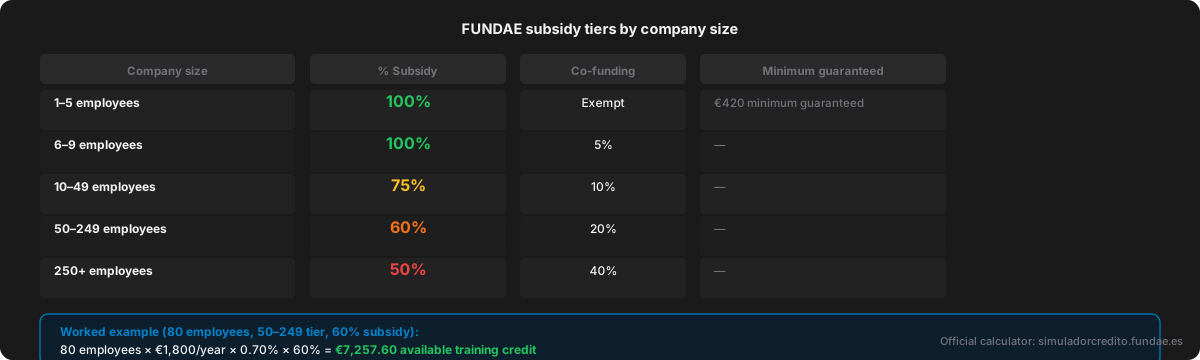
Subsidy tiers by company size
There is no mystery here. FUNDAE sets subsidy percentages based on company size:
| Company size | % Subsidy | Company contribution |
|---|---|---|
| 1 to 5 employees | 100% (minimum €420) | Exempt |
| 6 to 9 employees | 100% | 5% |
| 10 to 49 employees | 75% | 10% |
| 50 to 249 employees | 60% | 20% |
| 250+ employees | 50% | 40% |
(Source: FUNDAE official)
The formula is simple: take the vocational training contribution (0.70% × contribution base × 12 months × number of employees) and apply your tier's subsidy percentage.
If you have fewer than 6 employees, you have a guaranteed minimum of €420. It is not a lot, but it covers a worthwhile course.
Practical tip: FUNDAE has a free official simulator where you can calculate your credit in two minutes. Use it before planning anything.
Worked example: SME with 80 employees
Take a company with 80 employees and an average contribution base of €1,800.
- Annual vocational training contribution: 0.70% × €1,800 × 12 months × 80 employees = €12,096
- Subsidy percentage (50 to 249 tier): 60%
- Available credit: €7,257.60
That is more than €7,000 you can recover for training your team. Money you've already paid, which disappears if you don't use it before 31 December.
Mandatory company contribution: what it is and how to meet it
If your company has more than 5 employees, you must contribute part of the training cost from your own pocket. That is the private contribution requirement. Percentages are in the table above.
Here is the trick many companies don't know: you can meet the contribution requirement through salary costs if training takes place during working hours and employees don't lose any pay during the training time (FUNDAE official). In other words, the salary you pay employees while they are in training counts as your contribution. You don't necessarily need to put in extra money.
This changes the calculation significantly for SMEs. If you schedule training during working hours, you cover that contribution through salaries you're already paying. One nuance: if training is partly outside working hours, only the in-hours portion counts towards your contribution. Factor that in when scheduling.
The full legal framework (with real references)
This is what sets this guide apart. We don't say "according to current regulations" without telling you which ones. Here are the specific references so you can answer with confidence if anyone asks.
Law 30/2015 and Royal Decree 694/2017: the foundation
Law 30/2015 (BOE-A-2015-9734) is the legal umbrella. Royal Decree 694/2017 (BOE-A-2017-7769) is the implementing regulation that spells out how things work in practice: which types of training are covered, how they are funded, what requirements companies and training providers must meet, and how acquired competencies are accredited.
The two key documents to bookmark:
- Law 30/2015: BOE-A-2015-9734
- RD 694/2017: BOE-A-2017-7769
Article 23 of the Workers' Statute: 20 paid training hours
Many HR managers don't know this one. Article 23 of the Workers' Statute (Royal Legislative Decree 2/2015, BOE-A-2015-11430) gives employees with at least one year's seniority the right to 20 paid hours of job-related vocational training per year, linked to the company's activity.
Those hours accumulate over up to five years, provided the company has an active training plan that allows for accumulation. Training time counts as effective working time. Your collective bargaining agreement may improve on this statutory minimum.
An important nuance: this right to 20 hours is considered fulfilled when the company already offers vocational training as part of a company-initiated training plan or one agreed through collective bargaining (Art. 23.3 in fine ET). If your company already has an active training plan, the individual 20 hour leave may not be separately enforceable.
That said, this means employees have a legal right to train during working hours, on top of the FUNDAE credit. The two mechanisms complement each other: the credit funds the cost of training, and Art. 23 ET guarantees the time to receive it.
Competency mapping: a practical guide for HR →
Royal Decree 1189/2025: what changes in 2026
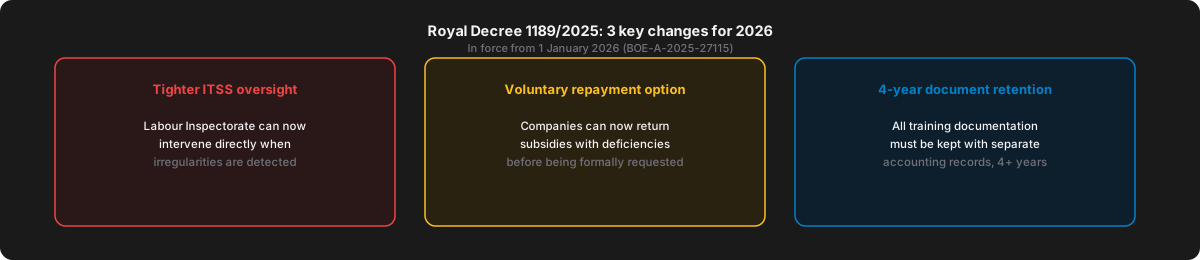
From 1 January 2026, RD 1189/2025 of 26 December (BOE-A-2025-27115) amends Article 18 of RD 694/2017 and tightens oversight of the system. The main changes you need to know:
Tighter Labour Inspectorate oversight: When Spain's Public Employment Service (SEPE) detects irregularities, it now passes the report directly to the Labour and Social Security Inspectorate (ITSS), which opens an administrative procedure. The process is faster and more serious than before.
Voluntary repayment: Companies can now voluntarily return the subsidy amount linked to detected deficiencies. Used well, this new mechanism can help you avoid larger penalties.
Reinforced accounting traceability: You must record training costs separately in your accounts and keep all documentation for at least four years (BOE-A-2025-27115).
That last point is new and significant. If you used to keep documentation "just in case", it is now an explicit legal obligation. Four years of invoices, attendance sheets, signature controls, training programmes... all of it.
How to manage subsidised training step by step

Before you start: how to access the FUNDAE platform
If you have never managed subsidised training, the first step is accessing the FUNDAE platform. The process is simpler than it looks:
- Go to fundae.es and navigate to the Companies section.
- You need a digital certificate for the company (the same one you use for Social Security or the Tax Agency) or an authorised representative with their own certificate. If your payroll agency already files Social Security contributions with a digital certificate, they can access on your behalf.
- Check your available credit using the official simulator or directly inside the platform once logged in.
- If you delegate to your agency or a training provider, they handle the access and you just approve. But you need to know your credit amount before anyone else decides how to spend it.
The first login takes 15 minutes if you already have a digital certificate. If you don't, getting one can take a few days. Don't let that be the excuse not to start.
Step 1: Assess training needs (before spending the credit)
This is the step everyone skips, and it's the most important one. Before deciding what training to buy with your credit, you need to know what your team actually needs. Not the other way around.
What we typically see is companies choosing training because "we need to spend the credit" or because a training provider offered them a catalogue. The result: generic language or IT courses that move nothing.
A training needs assessment means evaluating your team's current competencies, identifying the gaps and aligning training with business objectives. If you don't know where the shortfalls are, you're spending public money blindly.
FUNDAE's own data confirms this: of the €1,210 million assigned in credit in 2024, only €644.6 million was used, 53% of the total (FUNDAE, Balance 2024). Even companies that do access the system leave almost half their credit unused, often because they don't know what to invest it in. A prior competency diagnosis changes that dynamic.
Training needs analysis: step-by-step guide →
Step 2: Notify the Workers' Representatives committee (15 working days ahead)
This requirement catches many companies off guard. You must notify the Workers' Representatives (RLT) about the training plan at least 15 working days before the start date (FUNDAE official). The RLT has 15 days to issue a report.
The information you must include:
- Name, objectives and description of the training activities
- Target groups and number of participants
- Planned schedule
- Teaching methods and materials
- Participant selection criteria
- Planned delivery location
If your company has no RLT (common in SMEs), you must notify employees directly. Failing to carry out this step means you cannot claim the subsidy. It is not optional.
Step 3: File the training with FUNDAE (at least 2 days before)
The start of a training activity must be filed in the FUNDAE platform at least 2 calendar days before it begins. The completion is filed at least 1 day before the end.
Miss these deadlines and the training is treated as not having taken place, meaning no subsidy. There are no exceptions and no "I'll file it afterwards". Late filing means no subsidy.
Put these dates in your calendar and set reminders. These are the kind of things where missing a single day leaves no way back.
Step 4: Run the training and document it correctly
During delivery, documentation is where most problems arise. You need:
- Signed attendance sheets (in-person: daily signature, not all at the start)
- Login records (for online training)
- Detailed training programme
- Trainer's CV
- Participant evaluation
Training must meet basic requirements: minimum 2 hours, no more than 8 hours per day, maximum 30 participants per tutor in-person and 80 for online (Law 30/2015, Art. 14). Training must be free for employees. Charging participants for publicly funded training is a serious infringement (Law 30/2015).
On formats: training can be in-person, online or blended. According to FUNDAE 2024 data, 62.4% of subsidised training was in-person and 36.7% was online.
Under RD 1189/2025, documentation must be kept for at least 4 years and training costs must be recorded separately in the company's accounts (BOE-A-2025-27115).
Step 5: Apply the subsidy to Social Security contributions
Once training is complete and all documentation is in order, you apply the subsidy directly in your company's Social Security contribution form (TC1). It is a deduction on the monthly payment.
Remember: the credit runs within the calendar year. Anything you don't use by 31 December is gone. It does not carry over.
Managing in-house vs. using a training provider: what works best
You have two options:
Self-management: Your company handles everything directly on the FUNDAE platform. No intermediaries or special accreditation needed. It's free (apart from your time). The reform introduced by Law 30/2015 opened this route, making access more practical for SMEs.
External training provider: You delegate the administrative work to a specialist firm. It reduces the risk of errors but adds a cost.
Our recommendation: if your credit is under €3,000 and you have at least a basic HR setup, self-management is perfectly viable. If your credit is larger and you have no prior experience, a training provider can save you headaches in the first year. Once you know the process, you can consider managing it in-house.
The 5 mistakes that lose the subsidy (and how to avoid them)
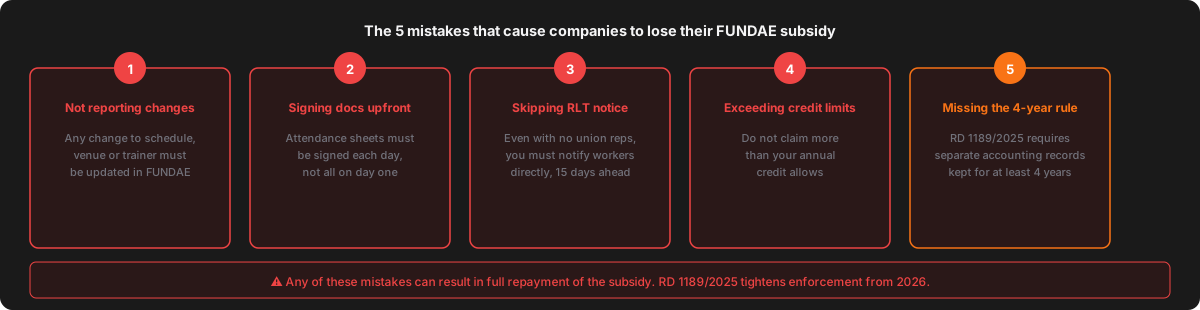
Mistake 1: Not reporting changes to FUNDAE
You filed the training on time, but then the schedule, venue or trainer changes. If you don't update FUNDAE, a spot inspection can void the subsidy. Every change, however minor, must be reflected on the platform.
How to avoid it: Assign one person to keep the FUNDAE platform up to date. Every change gets reported the same day.
Mistake 2: Deficient attendance documentation
The classic: getting all paperwork signed on day one "to have it ready". This is not allowed and puts the subsidy at risk. Attendance sheets must be signed on each day of training.
How to avoid it: Prepare attendance sheets per session. The trainer collects them signed at the end of each day. No exceptions.
Mistake 3: Not notifying the Workers' Representatives
Notifying the RLT (or employees directly if there is no RLT) is a mandatory requirement. Skipping it invalidates the subsidy (FUNDAE official).
How to avoid it: Add RLT notification as the first item on your checklist, 15 working days before any training activity starts.
Mistake 4: Exceeding subsidy limits
Claiming more than your credit allows, not respecting contribution percentages, or exceeding the maximum subsidy per participant. These limits vary by delivery format and duration, and many companies breach them without realising it, especially for in-house training with high costs or small groups. These errors show up in audits and require repayment, potentially with surcharges (Law 30/2015 and RD 694/2017).
How to avoid it: Calculate your credit with the FUNDAE simulator before planning. Track credit used vs. available on an ongoing basis. Before contracting any training, check the current maximum subsidisable cost per participant per hour on the FUNDAE platform for your delivery format.
Mistake 5: Not keeping documentation for 4 years (new from 2026)
Under RD 1189/2025 (BOE-A-2025-27115), retaining documentation for at least four years is now an explicit legal obligation. Invoices, training programmes, attendance sheets, evaluations, RLT notifications, everything.
How to avoid it: Create a digital folder per year and per training activity. Digitise everything. Set a reminder not to delete anything before the four-year mark.
Before spending your credit: why you need a competency assessment first
The generic training trap: spending the credit without knowing what you need
Many companies spend their FUNDAE credit on English or Excel courses because "something had to be done" and "the training provider offered it". Those courses are not inherently bad, but if they don't address a real need, the money is not well spent.
The pattern is always the same: November arrives, you realise you haven't used the credit, you call a training provider, they offer whatever they have available, and you end up training in competencies nobody needed to improve. The "we did training" box is ticked, but the real impact on the team is zero.
To put the scale of the issue in context: in 2024, 5.8 million training participations were recorded, though the actual number of unique workers who benefited was 3,378,343 (since one worker can attend several courses) (FUNDAE, Balance 2024). €644.6 million was used out of approximately €1,210 million in total allocated credit, 53% of the total (FUNDAE, Balance 2024). Even companies that do use the system don't exhaust their credit.
How a competency assessment optimises your FUNDAE training plan
The logic is simple: before deciding how to spend your credit, you need to know what competencies your team is missing. A competency assessment gives you that picture: what your people can do, where the gaps are and which training will have real impact.
When you connect a competency assessment with your FUNDAE training plan, concrete things happen:
- You invest the credit in what actually matters. Not what's offered to you, but what you need.
- You can justify training to leadership. It's no longer "we're doing training because it's time", it's "we're training in these competencies because we have a measurable gap".
There is also a third benefit on the legal compliance side: training needs detection is part of the process Law 30/2015 contemplates. Having objective data protects you if anyone questions your decisions.
The question that matters most is not how to recover the money, but how to invest it so the team genuinely improves.
In practice, companies that carry out a competency assessment before designing their training plan use a higher proportion of their FUNDAE credit (because they know exactly what training to buy) and generate visible impact on performance (because training addresses real gaps, not a generic catalogue). The prior diagnosis turns the FUNDAE credit from a formality into an investment with measurable return.
Want to know where to invest your FUNDAE credit before it expires? Start with the competencies that have the most impact right now: AI competencies. The free AI competency assessment from Skillia takes under 25 minutes and gives you your level across the most in-demand AI competencies, plus a personalised development plan. That is exactly the diagnosis you need to make every FUNDAE euro answer a real gap. Assess your AI competencies →
How to evaluate your team's AI competencies →
The first step is knowing where the gaps are. The free AI competency assessment from Skillia takes under 25 minutes and gives you your level across the most in-demand AI competencies, plus a personalised development plan. That is exactly the diagnosis you need so every FUNDAE euro answers a real gap. Assess your AI competencies →
Already clear that you need a solution for your team? Talk to us →
References
- [1] Law 30/2015, of 9 September, regulating the Vocational Training for Employment System. BOE-A-2015-9734
- [2] Royal Decree 694/2017, of 3 July, implementing Law 30/2015. BOE-A-2017-7769
- [3] Royal Legislative Decree 2/2015, of 23 October, Workers' Statute, Art. 23. BOE-A-2015-11430
- [4] Royal Decree 1189/2025, of 26 December, amending Article 18 of RD 694/2017. BOE-A-2025-27115
- [5] Ministerial Order PJC/178/2025, developing Social Security contribution rules. BOE-A-2025-3780
- [6] FUNDAE (2024). Balance de Situación de la Formación Programada 2024. ↗ Fuente
- [7] FUNDAE. Training credit simulator. ↗ Fuente
Last updated: March 2026. Always verify the latest updates at BOE and FUNDAE official sources.
Frequently Asked Questions
What is FUNDAE subsidised training in Spain?
FUNDAE subsidised training (formación bonificada) is a Spanish public system that allows companies to fund employee training through rebates on Social Security contributions. It is regulated by Law 30/2015 (BOE-A-2015-9734) and managed by FUNDAE (Spain's State Foundation for Employment Training). Each company receives an annual credit calculated from its workforce and the previous year's contributions.
Which companies can access FUNDAE subsidised training?
All companies based in Spain that contribute to vocational training through Social Security and are up to date with the Tax Agency and Social Security. Company size and sector don't matter. Even micro-companies with 1 to 5 employees have a guaranteed minimum credit of €420 per year (FUNDAE official).
Is the credit lost if not used?
Yes. The credit is annual and expires on 31 December each year. It does not carry over. According to FUNDAE data (Balance 2024), only 20.5% of Spanish companies actually use their credit.
What happens if my company has no Workers' Representatives (RLT)?
You must notify employees directly about the planned training. The absence of a Workers' Representatives committee does not exempt you from the notification requirement. Failing to carry out this step prevents you from claiming the subsidy (FUNDAE official).
Can online training be subsidised?
Yes. Under Article 14 of Law 30/2015 (BOE-A-2015-9734), training can be in-person, online (distance learning) or blended. In 2024, 36.7% of all subsidised training was delivered online (FUNDAE, Balance 2024). Attendance control requirements differ (login records instead of signature sheets), but the subsidy works the same way.
What is an Individual Training Leave (PIF) and how does it differ from the training credit?
An Individual Training Leave (Permiso Individual de Formación, PIF) allows an employee up to 200 working hours for accredited formal education. The company subsidises salary costs during the leave. This is different from the training credit: the PIF covers employee-chosen formal qualifications, while the credit funds company-planned training. PIFs do not consume the company's FUNDAE training credit (FUNDAE official).
What changes does Royal Decree 1189/2025 introduce for 2026?
RD 1189/2025 (BOE-A-2025-27115), in force from 1 January 2026, strengthens oversight of the system. The main changes: the Labour Inspectorate (ITSS) can now intervene directly when irregularities are detected; companies can make voluntary repayments for subsidies with deficiencies; and all documentation must be retained for at least 4 years with separate accounting records.
How do I calculate my company's FUNDAE training credit?
The credit is calculated as: vocational training contribution (0.70% × contribution base × 12 months × number of employees) multiplied by the subsidy percentage for your tier (100% for 1 to 9 employees, 75% for 10 to 49, 60% for 50 to 249, 50% for 250+). Companies with up to 5 employees have a guaranteed minimum of €420. FUNDAE provides a free official calculator at simuladorcredito.fundae.es.
Related articles
Agile learning in the workplace
How to plan training and make the most of your FUNDAE credit using agile learning cycles. A practical guide with 4 principles and a quarterly sprint plan for Spanish SMEs.
Jordi Catafal
Competency-based hiring: a practical guide to selecting candidates by what they can actually do
A 5-step framework for implementing competency-based hiring in SMEs, connected to the FUNDAE subsidised training credit. No academic theory. Practical method, evidence-backed data and ready-to-use scorecards.
Jordi Catafal
How to conduct a training needs analysis: a step-by-step guide for HR teams
A step-by-step guide to conducting a training needs analysis that produces reliable results: from identifying strategic competency gaps to building a continuous measurement practice.
Jordi Catafal