What Is Competency Assessment? A Practical Guide for HR Teams

Your CEO asks: "What competencies does our team have?" You know the question matters. What you don't have is a data-backed answer. You sense that production needs technical training, that sales is short on negotiation, and that most managers haven't had any development in over a year. But gut feelings aren't data.
Only 8% of organizations have reliable data on the competencies of their workforce, according to Gartner [1]. The remaining 92% make hiring, training, and promotion decisions on guesswork. This guide explains what competency assessment is, why it matters, and how to launch one without needing a consultancy or a six-month project.
Competency assessment vs. performance evaluation: the difference that changes what you do with it
Definition: A competency assessment is the systematic process by which an organization identifies, measures, and documents the skills, knowledge, and behaviors its employees have relative to what their roles require — now or in the future.
If you already run performance evaluations, don't start from scratch. The difference between the two processes is one of time perspective.
Performance evaluation tells you whether someone met their objectives this year. It looks backward. It's the tool for variable pay, recognition, and role continuity decisions.
Competency assessment tells you whether someone has the capabilities to do their job well next year. It looks forward. It's the tool for training, development, and succession planning.
Here's a concrete example: you have a maintenance technician who met all their objectives this year. Performance evaluation says they're fine. But if the company is introducing machinery with a digital control system they've never touched, the competency assessment tells you there's a gap to fix before it becomes a performance problem.
| Performance evaluation | Competency assessment | |
|---|---|---|
| Question it answers | Did they meet their objectives? | Do they have what they need for the next cycle? |
| Used for | Compensation, recognition | Training, development, succession planning |
| Perspective | Retrospective (past) | Prospective (future) |
Two tools. Different questions. Companies that only have one are working with half the picture.
Why 92% of companies make talent decisions blind
Gartner surveyed 190 HR executives in 2024 and the result was uncomfortable: only 8% of organizations have reliable data on the competencies of their workforce [1]. The remaining 92% base training, promotion, and hiring decisions on intuition and course completion histories — which is not the same as knowing whether someone actually has a competency.
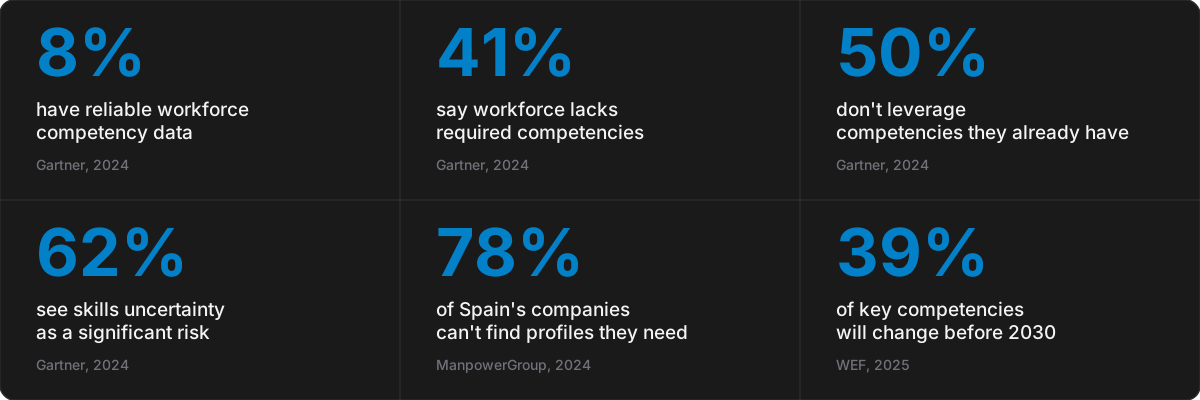
The same survey found that 41% of HR leaders say their workforce currently lacks required competencies, 50% admit their organization doesn't effectively use the competencies it already has, and 62% see uncertainty about future competencies as a significant risk [1].
In Spain, the problem goes further: 78% of companies say they struggle to find the profiles they need [3]. Part of that is the external market. But part of it is internal: competencies that already exist in the company but are unidentified, unmanaged, and disconnected from available training.
The World Economic Forum projects that 39% of key competencies will change before 2030 [2]. Part of what your team knows how to do today won't be enough in four years. A competency assessment tells you exactly where those gaps are now.
The legal side that most HR leaders overlook
In Spain, competency assessment isn't just a management best practice. It has legal backing.
Article 23 of the Workers' Statute [4] gives employees the right to training when their role changes. The Supreme Court has developed this further: if an employee can't adapt to changes in their role and the company can't show it identified the gaps and offered training, dismissal for failure to adapt (Art. 52.b ET) is in a weak position before an employment tribunal.
Two practical implications worth knowing:
Competency assessment is documentation with legal value. A report identifying a gap, an associated training plan, and a record showing the employee had access to that training are what strengthen the employer's position in proceedings for failure to adapt. Assessment isn't the only valid instrument, but it's the one that best documents the chain of action. One caveat: documenting the assessment and offering training strengthens your position but isn't an automatic guarantee. Outcomes depend on the sector, the applicable collective agreement, and the procedural timeline of each case. Talk to your employment lawyer before acting in that context.
If you have more than 50 workers and a Works Council, you're already required to inform the council of your annual training plan. The competency assessment is what gives that plan something to say. Without a diagnosis, a training plan is just a list of courses.
The 5 methods for assessing competencies
No single method works for every company. Pick the one that fits your size, budget, and the type of competency you're measuring.
Self-assessment
The employee rates their own proficiency in each competency. Fast and cheap, but results are systematically biased — upward when someone wants to access an opportunity, downward when they lack confidence. Don't use self-assessment as your only source. Always combine it with manager ratings.
360° feedback
The person being assessed gets ratings from their direct manager, peers, and direct reports. The most complete method for transversal competencies: communication, leadership, teamwork, change management. One warning for SMEs: in companies of fewer than 100 people where everyone knows each other, genuine anonymity is hard to guarantee, and that distorts results. If the rater knows there are only two people in the department, they can figure out who said what. In those cases, design evaluator groups of sufficient size and explain how confidentiality is protected before you launch.
For a company of 80 people, a full 360° for every role may be too heavy for a first assessment. More practical: self-assessment plus manager rating for everyone, full 360° only for management roles.
Technical tests and knowledge assessments
Written or practical tests that measure mastery of role-specific skills: programming, accounting, languages, machine operation. The most objective method when well designed. The obvious limitation: they only work for competencies with a correct or verifiable answer.
Competency-based interviews (STAR method)
Structured interviews where the person describes specific past situations to infer behavior. The STAR method (Situation, Task, Action, Result) turns those answers into behavioral indicators. Works well for critical roles where no technical test applies. Requires time and interviewers trained in the method.
Assessment center
The method with the highest predictive validity for executive or highly specialized roles: work simulations, role plays, psychometric tests, interviews. Takes 4 to 8 hours per person and trained observers, so it's reserved for high-stakes decisions. Worth knowing: research on assessment center validity documents a systematic halo effect, where observers end up rating the candidate's overall performance in the exercise rather than the specific competencies being measured [6].
| Method | Relative cost | Best for |
|---|---|---|
| Self-assessment | Very low | Always as a complement; never as the only source |
| 360° feedback | Low–medium | Transversal competencies, management roles |
| Technical tests | Low | Verifiable competencies with a correct answer |
| STAR interview | Medium | Behavioral competencies in critical roles |
| Assessment center | High | Executives, succession, senior selection |
How to run a competency assessment: step by step
This guide is built for HR teams of 1 to 3 people in companies of 50 to 300 employees.
1Define what competencies your company actually needs
The most common mistake here is trying to get it perfect from day one. If this is your first competency assessment, start small.
For companies under 150 people: 5 competency domains is enough. Not 10, not 20. Five, chosen based on where the business needs to go in the next 12–24 months.
The minimum viable process: talk to the CEO and 2–3 area managers (30 minutes each, 3 conversations cover a company of 50–150 people). Ask: "What does this team need to do better for the business to work well next year?" Turn those answers into competencies by role — not for the whole company — and define three proficiency levels: basic, developing, competent. Validate the map with managers before you use it to assess.
Anti-pattern to avoid: Don't try to build the complete competency map for all roles before doing your first assessment. That's the fastest path to analysis paralysis: the map takes months, the strategy shifts in the meantime, and the assessment never happens. Start with the 5 domains that hurt the business most right now. The map is built by assessing, not by planning.
If you already have a performance evaluation process: Don't launch the competency assessment as a separate process. Add it as an extra dimension of the same cycle. Less burden on managers, higher participation rates.
Guide: how to build a competency map step by step →
2Choose a method you can actually sustain
The best competency assessment isn't the most sophisticated — it's the one you can maintain with your resources. For most SMEs with 1–2 HR staff, self-assessment plus direct manager rating is the right call: 80% of the value of a full 360° with 20% of the effort.
If managers are pressed for time, don't try to do everything at once. Start with the most critical roles and expand in future cycles.
Want objective data before you design your own process? Skillia's free AI competency assessment takes under 25 minutes and gives you proficiency levels across the most in-demand AI skills plus a personalized development plan. No long forms, no self-assessment bias. Exactly the kind of starting point this step needs. [Assess your AI competencies →]
3Design the assessment form
For a first assessment, nothing complicated is needed. Google Forms with a 1-to-4 scale (no midpoint, to force a position) works fine for companies up to 100 people assessing 5–10 domains. Specialized software earns its place once you go beyond that, or when you need to automate individual gap reports.
One thing that always helps: include an open-ended question at the end — "In what area do you most need development to do your job well over the next 12 months?" It generates qualitative data that scales don't capture, and it gives employees a voice, which improves how the process is perceived.
4Launch the assessment and keep participation up
Before you launch, explain the process: what's being assessed, why, who sees the results, and how they'll be used. Assessment processes that create distrust are the ones that don't explain what the data is for.
Set a two-week window. The reminder on day 10 is what separates 60% participation from 90% in most companies.
5Analyze results and make actual decisions
A report that generates no decisions is an administrative exercise. What you need out of it: a gap map by role and area, a priority list of which gaps to address first (business impact times gap size), and concrete next steps.
For each gap, three questions help: How long before this becomes a performance problem? Is it better to develop this competency internally or hire for it? What budget is available?
If you use an HRIS, check what training data you already have. Tools like BambooHR or Workday let you associate completed training with competencies, which gives you a baseline without building from zero. If you need to automate the assessment itself — adaptive questionnaires, role-based gap analysis, and a direct link to your training plan — Skillia does that for HR teams of 1 to 3 people without a consultancy involved.
How to use your FUNDAE training credit for the training that actually matters
Your company has a training budget the law already provides. The problem isn't the money — it's knowing where to put it.
Every company with employees contributing to Social Security generates an annual subsidized training credit through the Vocational Training levy. The credit doesn't roll over: unused at year-end, it's gone [5].
How it works: the company calculates its credit based on the previous year's contributions, with a coefficient that varies by headcount. That credit subsidizes training run through FUNDAE. The company runs the training, pays the accredited provider, and deducts the subsidy from the TC1 for the month the training ends. You have several months after completion to apply the subsidy — don't write off the credit just because you didn't apply it immediately.
Three things to get right before you plan:
The credit doesn't carry over. Many companies hit December with unused credit because they didn't plan training in time. A competency assessment in Q1 is what prevents that.
Subsidizing in-house training requires prior SEPE accreditation for the company or internal provider. Don't assume any training delivered by a company employee is automatically subsidizable.
You must notify FUNDAE before the training starts, not after. This is the operational detail that kills the credit most often: companies run the training correctly but don't log it in FUNDAE before day one, and the subsidy is invalidated regardless of everything else being in order.
Without a prior diagnosis, FUNDAE credit gets spent on generic catalogue training. With a documented competency gap analysis, every FUNDAE euro is tied to an identified need and the return is defensible to management and auditors [5].
Full guide to FUNDAE subsidized training →
The 5 reasons competency models fail
Competency models fail more often than people admit. The five most common reasons in Spanish companies — from the first representative empirical study on competency management in Spain, consistent with what practitioners still see on the ground [6]:
1. Too many competencies. Models with 20–50 competencies that nobody can actually manage. If a manager has to assess 8 people on 40 competencies, they'll do it on autopilot or not at all. Five well-defined domains are worth more than 40 vague labels.
2. Abstract definitions. "Customer orientation," "transformational leadership," "proactivity" don't mean the same thing to the logistics manager and the commercial director. Competencies need concrete, observable behaviors — not consultant vocabulary.
3. No strategic alignment. The model reflects what HR thinks matters, not what the business needs to do in the next 12–24 months. If the company is entering an international market and the model doesn't include language skills or cross-cultural negotiation, the diagnosis is outdated before it's published.
4. No tools to keep it running. Assessing 80 people on 10 competencies twice a year, manually, is not feasible for a small HR team. Without automation, the process collapses in the second cycle.
5. No maintenance. The model is defined once and never touched again. 39% of key competencies will change before 2030 [2]. A model that isn't reviewed annually stops being useful fast.
How to present results to management in 10 minutes
Your CEO doesn't need the full report. They need three things.
First: the uncomfortable finding, framed as a business problem. Not "60% of the production team is at basic level in preventive maintenance." But: "If we launch the second shift in July with the current team, 60% of operators don't have the technical level that shift needs."
Second: the cost of not acting. External hiring, delays, incidents, operational risk. A concrete number — even a reasoned estimate — does more work than any qualitative risk description.
Third: the recommendation with a number and a deadline. "Training for 15 operators, €4,200, €3,100 subsidizable through FUNDAE, ready by May 30 if you approve before April 15."
Your CEO doesn't have to interpret that. They say yes or no.
One thing worth knowing: the most uncomfortable finding is rarely the technical gap. Management usually senses that before you arrive — the team that doesn't know the new machinery, the lack of English for the international client. What surprises people is the management layer. Middle managers systematically overrate themselves on leadership and team development. An assessment that includes ratings from their direct reports tends to reveal gaps between how managers see themselves and how their teams see them. For a CEO who thought the problem was "not enough technical talent," finding out the bottleneck is the management layer is a very different conversation. Usually a more useful one.
The most practical first step
If this is your first assessment and you have fewer than 50 people, Google Forms and a spreadsheet are enough. Everything you need is in this guide.
But before you design forms, you need to know where you stand. The fastest way to get there is an assessment that gives you objective data — not self-reported guesses.
Ready to assess your team's AI competencies? Tell us your case and we'll show you how it works in practice. Request a demo →
References
- [1] Gartner (2024). "Gartner HR Research Finds Only 8% of Organizations Have Reliable Skills Data." ↗ Fuente
- [2] World Economic Forum (2025). Future of Jobs Report 2025. ↗ Fuente
- [3] ManpowerGroup Spain (2024). Talent Shortage Study Spain 2024. ↗ Fuente
- [4] BOE (2015). Royal Legislative Decree 2/2015, of 23 October, Workers' Statute, Art. 23 and 52.b. ↗ Fuente
- [5] FUNDAE. "How to get subsidized." ↗ Fuente
- [6] Elsevier / Contaduría y Administración (2013). "An Analysis of Competency Management in Spanish Companies." ↗ Fuente
Frequently Asked Questions
What is a competency assessment?
A competency assessment is the systematic process by which an organization identifies and measures the skills, knowledge, and behaviors its employees possess relative to the competencies required for their roles. Its goal is to detect gaps between the current and required profile in order to make informed decisions on training, development, or hiring.
What is the difference between competency assessment and performance evaluation?
Performance evaluation measures whether an employee has achieved their objectives in the past period (retrospective). Competency assessment measures whether the employee has the capabilities to execute their role in the future period (prospective). They are complementary: the former informs pay decisions; the latter informs training and development decisions.
How long does a competency assessment take?
For a company of 50–150 people with 1–2 HR staff, using self-assessment plus manager ratings across 5 competency domains: 6 to 10 weeks. The intensive HR work is concentrated in design (weeks 1–2) and results analysis (weeks 7–8). Employee time on the form is 20–30 minutes. In real HR working hours: around 4–6 hours for design interviews and synthesis of the competency map, 2–3 hours to design the form, 1–2 hours for the launch and participation follow-up, and between 4 and 8 hours to analyze results and produce the report. In total, 12–20 hours of HR work spread across the process, with the load concentrated at the beginning and end. If managers have limited availability, work in phases: validate the most critical roles first (first 4 weeks) and expand to the rest in the next cycle.
What is the difference between technical and transversal competencies?
Technical competencies are role-specific knowledge and skills (programming, accounting, machinery operation, languages). They are measured with tests or practical assessments. Transversal competencies are capabilities that apply across multiple roles: communication, leadership, teamwork, stress management. They require 360° assessment or interviews to be captured reliably. A competency model that only evaluates technical competencies misses the transversal ones — which are the best predictors of long-term performance and adaptability.
Can a competency assessment be done without specialized software?
Yes. For companies of up to 100 people with 5–10 competency domains, Google Forms plus Sheets covers the distribution, data collection, and basic gap analysis perfectly. The threshold where manual processes stop scaling is around 30–50 people assessing more than 5 domains: the first assessments start becoming outdated before the last ones are finished. Beyond that point, keeping the competency inventory current manually requires an effort that small HR teams cannot sustain. Specialized software adds real value in three situations: when you need to automate individual gap reports, when you want to connect the assessment continuously to the performance cycle and training plan, and when methodological rigor matters.
How does competency assessment relate to FUNDAE?
Competency assessment is the planning step that turns FUNDAE credit into strategic training. The flow is: competency assessment → identification of priority gaps → training plan design → FUNDAE subsidy of approved actions. Without that first step, the credit tends to be spent on generic catalogues with no measurable impact.
Is competency assessment mandatory in Spain?
There is no direct legal obligation to conduct periodic competency assessments. However, Article 23 of the Workers' Statute establishes the employer's duty to provide adaptation training when the employee's role changes. The competency assessment documents the gap diagnosis and grounds the training plan, which strengthens the employer's position in the event of employment proceedings for failure to adapt (Art. 52.b ET).
How often should a competency assessment be repeated?
Annually is the minimum reasonable frequency, synchronized with strategic planning and the performance cycle. The value of the assessment grows with each repetition: the second assessment already tells you whether the gaps from the previous year have been closed. For roles in rapid transformation (technology, digital operations), a semi-annual review may be justified.
Related articles
Competency map
A practical guide to building a competency map for your SME. 5 steps, common mistakes, FUNDAE subsidised training, and up-to-date skills data.
Jordi Catafal
Agile learning in the workplace
How to plan training and make the most of your FUNDAE credit using agile learning cycles. A practical guide with 4 principles and a quarterly sprint plan for Spanish SMEs.
Jordi Catafal
Competency-based hiring: a practical guide to selecting candidates by what they can actually do
A 5-step framework for implementing competency-based hiring in SMEs, connected to the FUNDAE subsidised training credit. No academic theory. Practical method, evidence-backed data and ready-to-use scorecards.
Jordi Catafal