Agile learning in the workplace

Your company has a training budget assigned by law. And the chances are you're either not using it well, or not using it at all.
That's not a criticism. It's what happens to 80% of Spanish companies. (FUNDAE / ADR Formación, 2024)
The problem is not the money. The problem is not having a process to decide what to spend it on.
That's where agile learning comes in: an approach that applies short cycles, continuous diagnosis and outcome measurement to training planning. Not as a buzzword, but as the practical method that turns FUNDAE credit into training that genuinely closes skills gaps in your team.
This guide is written for the L&D Manager or HR Director at a Spanish SME of 50 to 200 employees who wants to stop buying catalogue training blindly and start investing their FUNDAE credit in what their team actually needs.
FUNDAE subsidised training: complete guide to managing your company's credit →
What agile learning is (and what it isn't)
Agile learning is not a type of course. It's not about making courses shorter, or replacing in person training with five minute videos. And it is certainly not installing an e-learning platform and calling it transformation.
It is a different way of planning, running and measuring training inside your company. An approach that applies the principles of agile methodologies (short cycles, continuous feedback, iterative improvement) to the process of identifying, designing and deploying training.
A related but distinct concept is individual learning agility: a person's capacity to learn, unlearn and relearn quickly. Research by Lombardo and Eichinger (cited by Korn Ferry) considers it a stronger predictor of future professional success than current performance or existing technical skills. That research refers to a personal attribute, not an organisational methodology. But the underlying logic is the same: if the competencies you need are changing fast, the capacity to adapt matters more than the current inventory. Agile learning in the workplace is the process that makes that adaptation possible in a systematic way.
The difference between one-off training and continuous learning
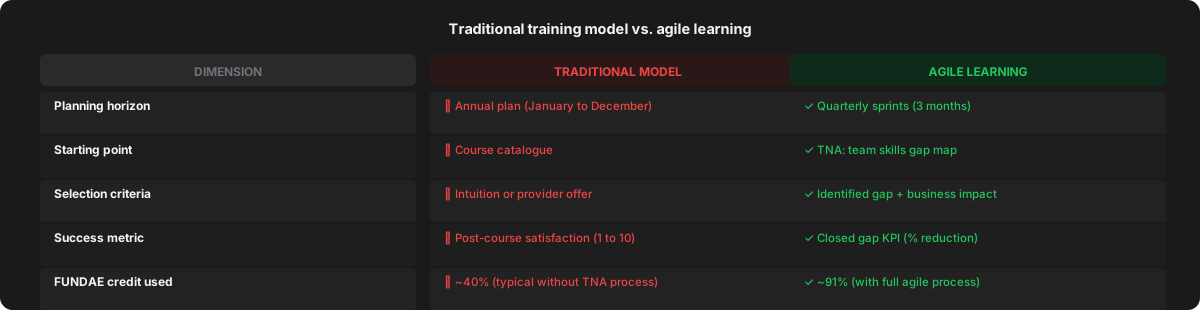
Traditional training at a Spanish SME works like this: at the start of the year a training plan is drawn up, courses are selected from a catalogue, the available FUNDAE credit is spent and in December people are asked whether they "were satisfied". That cycle runs for twelve months and there is little room to correct course.
Agile learning works in three-month cycles. You identify what your team needs now, design short and applicable training, measure whether it's working and adjust for the next quarter. It's not more work. It's the same work better distributed across time.
The key difference: in the agile model, training responds to an identified need. In the traditional model, it responds to an available catalogue.
Why the "one course a year" model no longer works
According to the World Economic Forum's Future of Jobs Report 2025, 39% of the skills your employees have today will be obsolete by 2030, and 59% of workers will need additional training to remain effective in their own role. (WEF, Future of Jobs Report, 2025)
Five years is less time than it seems when the training plan is designed in January and reviewed in December.
If the pace at which required skills change is faster than the pace at which your company detects and closes those gaps, the standard annual training plan will always arrive too late.
The figure that changes everything: 80% of Spanish companies don't use their FUNDAE credit

Before talking about methodology, there is a widespread misconception to clear up: most L&D Managers at SMEs believe their company doesn't have enough training budget. The data says otherwise.
In Spain, every company with employees registered with Social Security makes a mandatory contribution to a training fund. In return, it receives an annual subsidised training credit that it can use to fund employee training through the FUNDAE system.
The problem is that credit is not being used.
According to FUNDAE and ADR Formación data from 2024, only 20% of potentially eligible companies carried out subsidised training that year. The other 80%, the vast majority of Spanish SMEs, didn't use their credit. (FUNDAE / ADR Formación, 2024)
The figure is even more striking when you look at it from the financial side: companies that did use the system only spent 53% of available credit, €644 million out of €1,210 million available. (FUNDAE, Balance de Formación Bonificada, 2024) More than €560 million of training, legal and practically free for the company, went to waste.
The reason is not negligence or indifference. The reason is that without a process for detecting what the team needs, there is no way to decide with any confidence where to invest the credit. You end up buying whatever is in the catalogue, without knowing whether it's what you actually need.
If your company has employees, you already have a training budget: your subsidised training credit. The agile Training Needs Assessment (TNA) is what tells you what to invest it in.
FUNDAE subsidised training: how to calculate your credit →
The 4 principles of agile learning in the Spanish SME
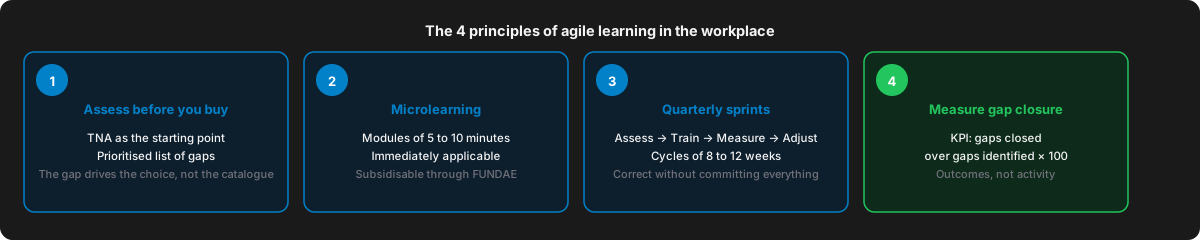
Applying agile learning in a company of 50 to 200 people, with an HR team of one to three people and no dedicated L&D department, does not require cultural transformation. It requires changing four habits.
1. Assess before you buy: the agile TNA as the starting point
The most common mistake in Spanish corporate training is buying courses without a prior analysis of what the team actually needs. Training ends up being a catalogue of options chosen by intuition, convenience or because the sales rep was very persuasive.
The agile Training Needs Assessment (TNA) is not a six-month process with external consultants. It is an evaluation of your team's current competencies against the competencies the business needs now and over the next twelve months. The output is a prioritised list of gaps: what's missing, in which roles, with what urgency.
That list is what guides the FUNDAE credit spend. Not the catalogue.
Competency assessment tools, from a well-designed spreadsheet to platforms that automate the process, allow you to maintain that visibility continuously: there is no need to wait for the next annual survey or performance review to know where the gaps are.
According to ManpowerGroup Spain, 80% of mid sized companies (50 to 249 employees) report difficulty filling vacancies due to a lack of suitable candidates in the market. (ManpowerGroup Spain, Talent Shortage Study, 2025) If hiring the talent you need is getting harder, and the data says it is, the only realistic alternative is developing talent internally. And to do that effectively, you need to know exactly which competencies are missing.
2. Modules instead of blocks: microlearning as the default format
The block training model (full day sessions, 40 hour courses) has two problems in the SME context: it is expensive in lost time and retention rates are low.
Microlearning, modules of 5 to 10 minutes focused on one specific skill and available at any time, solves both problems. Various studies on knowledge retention indicate that short formats spaced over time significantly improve retention compared to traditional long sessions, though ranges vary depending on context and study methodology. FUNDAE's own blog has cited this evidence as an argument in favour of microlearning in subsidised training (FUNDAE Blog, 2024).
The fact that the very body managing Spain's training credit validates this methodology matters: microlearning works better and is also fully subsidisable through the FUNDAE system when courses are properly documented within the company training plan.
For an SME where employees cannot afford to be absent from their roles for days, microlearning is also a practical response to a real operational problem: training that fits within the working day without disrupting it.
3. Short cycles and fast feedback: training sprints
Agile learning borrows the concept of the sprint from software development methodologies. Rather than committing all available FUNDAE credit at the start of the year to a twelve month plan, you work in quarterly cycles.
In 2025, eFundae launched official training itineraries in Agile Methodologies (Scrum, OKR, SAFe, Kanban, Lean) and Digital Competencies. (FUNDAE, Noticias, 2025) The signal is clear: agile learning is not an Anglo-Saxon trend. It is the official direction of the Spanish training system.
Each quarter you run one cycle: identify priority gaps, design or select training to close them, deliver it, and measure whether it worked before the next quarter begins. What worked is consolidated. What didn't is adjusted or dropped.
This approach has a direct benefit for FUNDAE credit management: you distribute the investment over time, you can correct planning errors without having committed the entire budget, and each quarter you have real data on the impact of the previous training.
4. Measure to adjust: the closed gap KPI
How do you know whether training is actually doing anything?
The post-course satisfaction metric, "on a scale of 1 to 10, how would you rate the training?", does not tell you whether the employee can now do something they couldn't before. It is a measure of experience, not impact.
Agile learning proposes measuring gap closure: before training, the employee is at level X in the competency they need to develop. After training, where are they? Has the distance between what the role requires and what the employee knows narrowed?
This change in metric has a direct effect on justifying investment to leadership: instead of presenting training hours completed (an activity metric), you present competency gaps closed (an outcome metric). That measurement requires having done the competency assessment before the training, which is precisely the TNA from the first principle. The circle closes.
Competency mapping: a practical guide for HR →
How to connect agile learning with your FUNDAE training plan

This is what applying the four principles looks like in practice in the context of a company training plan.
Step 1: Assess your team's current competencies
Before opening any training catalogue, you need to know the starting point of each person on your team relative to the skills their role requires now and will require over the next year.
This assessment, your company's competency map, is the mandatory starting point. Without it, any training decision is a blind bet.
Tools for this assessment:
- Self assessments by competency (each employee rates their own level)
- Line manager assessments
- Knowledge or skill specific tests
- Competency assessment platforms that automate the process and generate the gap map directly
The competency assessment is the prerequisite that turns your FUNDAE investment into a defensible decision: you can show exactly what gap existed before the training and how much it closed afterwards.
Want to know what AI skills gaps your team has before planning this quarter's training? The free AI competency assessment from Skillia takes under 25 minutes and generates a personalised report with your level across the most in demand AI competencies, plus a personalised development plan. Start your first sprint with the competency that defines 2026: AI skills. Assess your AI competencies →
Step 2: Prioritise the most critical gaps for the business
Not all gaps have the same urgency. Some skills, if not developed in the next six months, will directly affect business results: a new product line, a regulatory change, entry into a new market. Others would be worth developing but can wait.
Prioritisation must be based on business impact, not planning convenience. The most urgent gaps are the ones the available FUNDAE credit covers first.
A simple way to prioritise:
| Gap | Business impact | Urgency | Priority |
|---|---|---|---|
| Competency A | High | High | 1 |
| Competency B | High | Low | 2 |
| Competency C | Medium | High | 3 |
| Competency D | Low | Low | 4 |
Priority 1 and 2 gaps are what your next quarter's training plan should cover.
This prioritisation is also the argument you need to justify the training plan to the leadership team: not "we bought X courses", but "these are the gaps most holding the business back and this is the plan to close them".
Step 3: Design a quarterly (not annual) plan with the available credit
With the prioritised gap list in hand, design the training plan in three month blocks. Quarterly, not annual: the longer horizon introduces too much uncertainty about business needs.
The quarterly plan includes:
- The gaps to close (from the prioritisation in the previous step)
- The training selected to close each gap
- The cost of each training activity
- The allocation of available FUNDAE credit to each activity
Designing the plan by quarter has an additional advantage: if in the second quarter the business changes direction, you have three more opportunities to adjust the training investment before the year ends.
Note on the Workers' Statute: For companies with a works council (generally from 50 represented employees), the Workers' Statute (Art. 64) requires informing the works council about training plans. This is a separate and independent process from managing the FUNDAE credit. For training involving workers represented by a works council, consult your employment lawyer to ensure the procedure is correct for your specific situation.
Consult your FUNDAE manager or training provider to confirm which components are subsidisable in your case.
Step 4: Measure the impact and adjust for the next quarter
At the end of the quarter, reassess the competencies you worked on in the training. Compare results with the initial assessment. Did the gap close? By how much? Are employees applying what they learned in their day to day work?
Calculate the closed gap KPI: (gaps reduced / gaps identified at the start of the sprint) × 100.
That measurement gives you the data for the next cycle: which training worked and should be repeated, which provider delivered real results, and which gaps are still open and need a different approach.
The quarterly review is also the moment to update the competency map. The business will have changed, roles will have evolved, and new gaps may have appeared that were impossible to foresee in January.
Worked example: a service company with 80 employees in Valencia
Picture a B2B services company with 80 employees in Valencia. Two person HR team: a generalist HR Manager and an administrator who supports personnel management. No dedicated L&D team.
The starting situation: Every November, the HR Manager goes around the departments, asks "what training do you need?" and gets vague answers: "advanced Excel", "business English", "something on leadership". She uses that to build the following year's training plan, allocates the FUNDAE credit and buys catalogue courses. They spend about 40% of the available credit. The rest expires.
With the agile model:
January. Agile TNA (2 weeks): They assess the competencies of the commercial team (8 people). They find the most urgent gap is not digital skills (which is what they were buying) but incident management with clients and assertive communication in coordination teams.
Week 3. Prioritisation: From the identified gaps, they select the two with the highest business impact (incident resolution time, client satisfaction index). These competencies are the objective of the first sprint.
Weeks 4 to 10. Training sprint: They design microlearning modules of 15 minutes, twice a week, fully subsidised through FUNDAE credit. Team coordinators complete the training during working hours with no full days of in person training.
Weeks 11 to 12. Measurement: They repeat the competency assessment. The level in incident management has improved visibly. The HR Manager can go to leadership with data: "We invested X euros of FUNDAE credit to close these gaps. The competency level has improved on these metrics." That is demonstrable training ROI. The catalogue model cannot offer that.
The key difference: They used 91% of their available FUNDAE credit, compared to 40% the previous year, and they have data to prove the impact.
Note: this example is illustrative and the timelines are optimistic for a first cycle. In practice, coordinating with department heads, collecting assessments and processing FUNDAE paperwork may extend the first few weeks. The first sprint is always the slowest. The second is much faster because competencies are already defined and the process is familiar.
The most common mistakes when implementing agile learning
Buying catalogue training without a prior diagnosis
This is the most widespread and most costly mistake. The training catalogue is a useful tool when you know exactly what you need. Without that prior diagnosis, it is like going to the supermarket without a shopping list after not checking what's in the fridge: you end up buying what catches your eye, not what you need.
According to analysis by Spanish corporate training specialists, the main reason training fails in companies is exactly this: training doesn't respond to real strategic needs because it was bought without a prior analysis of which competencies are missing. (CEI for Business / LosRecursosHumanos.com, 2024)
The result six or twelve months later is almost always the same: employees did the course, found it interesting, and have changed nothing about how they work. The FUNDAE credit was spent. The gap is still there.
The solution is structural: make the TNA the mandatory and non-negotiable first step before any training purchase decision.
Doing the diagnosis once and never repeating it
Many companies carry out an initial competency assessment, use it to design the year's training plan, and don't assess again until the following year. This turns the TNA into a formality, not a process.
Business needs change. Markets change. Projects evolve. If 39% of current competencies will be obsolete by 2030 (WEF, Future of Jobs Report, 2025), a diagnosis done in 2023 is not relevant in 2026.
The value of the agile TNA lies in repetition: each assessment cycle reveals whether the previous training worked and what new needs have appeared. Without repetition there is no agile learning. It is just a training plan with a different name.
Confusing microlearning with real training
Microlearning is a format, not a strategy. Short modules don't mean superficial modules. It means they are designed to be immediately applicable.
The mistake is treating microlearning as a way to "do some training" without committing to a real process. Ten disconnected modules, with no prior assessment, no impact measurement, is not agile learning. It is workplace entertainment.
Microlearning works when it forms part of an itinerary with a clear objective: this competency, at this level, for these people, by this date. Without that question resolved by the TNA, the format alone does not change the outcome.
The external talent shortage reinforces the urgency of internal development
Beyond FUNDAE credit, there is another argument for agile learning that directly affects Spanish SMEs: the growing difficulty of hiring external talent.
According to ManpowerGroup Spain's Talent Shortage Study 2025, 80% of mid sized companies (50 to 249 employees) and 79% of small companies (10 to 49 employees) in Spain have difficulty filling vacancies due to a lack of suitable candidates. (ManpowerGroup Spain, Talent Shortage Study, 2025)
If you can't hire the talent you need, the only alternative is to develop it internally. Agile learning is the methodology that makes that development possible in a systematic way, without a dedicated L&D team and with the FUNDAE credit you already have available.
Quick reference table: agile TNA process for SMEs
| Phase | Estimated duration | What happens | Output |
|---|---|---|---|
| Competency map | 1 to 2 weeks | Define competencies required by role | Competency map by role |
| Gap assessment | 1 to 2 weeks | Assess current vs. required level | Gap map by employee and role |
| Prioritisation | 2 to 3 days | Rank gaps by impact and frequency | Top 2 to 3 competencies for the sprint |
| Sprint design | 1 week | Select FUNDAE subsidisable training | Quarterly training plan |
| Training (sprint) | 4 to 6 weeks | Asynchronous microlearning | Training completed |
| Measurement | 1 to 2 weeks | Post-training assessment, closed gap KPI | Sprint impact report |
| Adjustment and next TNA | 2 to 3 days | Review results, start next sprint | Data for next quarter's TNA |
Ready to know where to invest your FUNDAE credit this year?
If you've been planning training from catalogues and gut feel for years, the shift to a diagnosis based process can seem like a big project. It isn't.
Start with one question: do you know exactly what skills your team is missing to do their jobs better over the next twelve months?
If the answer is "more or less" or "I have a sense of it", you have everything you need to justify the first step: a basic competency assessment, a real gap map and a FUNDAE training plan connected to what your company actually needs.
You already have the credit. The process is what's missing.
The first step is knowing where the gaps are. The free AI competency assessment from Skillia takes under 25 minutes and gives you your level across the most in demand AI competencies, plus a personalised development plan. That is exactly the diagnosis you need before designing your next FUNDAE sprint. Assess your AI competencies →
Already clear that you need a solution for your team? Talk to us →
References
- [1] FUNDAE / ADR Formación (2024). Balance de Formación Bonificada 2024. ↗ Fuente
- [2] World Economic Forum (2025). The Future of Jobs Report 2025. ↗ Fuente
- [3] ManpowerGroup Spain (2025). Talent Shortage Study 2025. ↗ Fuente
- [4] Lombardo, M. & Eichinger, R. / Korn Ferry. Learning Agility as predictor of leadership potential. Cited by Escuela de Mentoring España (2024).
- [5] FUNDAE Blog (2024). Microlearning and knowledge retention. ↗ Fuente
- [6] FUNDAE Noticias (2025). Official training itineraries in Agile Methodologies and Digital Competencies.
- [7] CEI for Business / LosRecursosHumanos.com (2024). Analysis of corporate training in Spanish SMEs.
Last updated: March 2026. Always verify the latest updates at FUNDAE's official sources.
Frequently Asked Questions
What exactly is agile learning in a company?
Agile learning in a company is the application of agile methodology principles (iteration, short cycles, continuous feedback) to the planning and delivery of training. Rather than one large annual training plan, agile learning organises training into quarterly sprints: assess gaps, train on those gaps, measure the result and adjust for the next cycle. It is not a type of technology or a platform. It is a way of managing training that connects directly to business objectives.
Does agile learning require a technology tool?
Not necessarily. A first agile learning cycle can be implemented with basic tools: a competency assessment in a form, a spreadsheet for the gap map and FUNDAE-subsidised courses. Technology, such as a competency assessment platform like Skillia, an LMS or a microlearning tool, speeds up the process and makes it scalable, but is not a requirement to get started. What is essential is having a training needs assessment process before selecting any training.
How do I start if my company has never done a training needs assessment?
The first step is simpler than it looks: start with one department, not the whole company. Define the 3 to 5 most urgent competencies for that team over the next 6 months. Assess each person on those competencies (self assessment plus manager validation). Identify the two most important gaps. Design training only for those two gaps. That first cycle, even if imperfect, is agile learning in action. The second cycle will be better. Within six months you have a complete competency map built incrementally.
Does the FUNDAE credit cover competency assessments?
FUNDAE subsidised training credit is designed to cover subsidisable training activities: courses, workshops and training programmes. A competency assessment itself is not a training activity and is generally not directly subsidisable as a standalone activity. However, the documentation resulting from that assessment, the training needs assessment (TNA) report, is exactly what FUNDAE needs as justification to approve the subsidy for the subsequent training. Consult your FUNDAE manager or training provider to confirm which components are subsidisable in your specific case.
How long does it take to implement a first agile learning cycle?
A complete first agile learning cycle, from needs assessment to post-training measurement, can be completed in 8 to 12 weeks in an SME of 50 to 200 employees. The assessment and gap detection phase typically takes 2 to 3 weeks, prioritisation and sprint design 1 to 2 weeks, the training itself between 4 and 6 weeks (with asynchronous microlearning), and impact measurement 1 to 2 weeks. The first cycle is always the longest because it involves building the competency map from scratch; subsequent cycles are progressively faster.
What is the difference between agile learning and agile methodology in HR?
Agile methodology in human resources refers to applying agility principles to people management processes in general: recruitment, performance review, workforce planning. Agile learning is a specific application of those principles to the training and development process. An HR department can adopt agile methodology in its recruitment processes without changing anything in training, and vice versa. This article focuses specifically on agile learning as a training planning process.
Why do 80% of Spanish companies not use their FUNDAE credit?
According to FUNDAE and ADR Formación (2024), the main reason companies don't use their subsidised training credit is not unfamiliarity with the system, but the absence of a process for identifying what to invest it in. Companies without a structured training needs assessment don't know what training to buy, so they either buy nothing or buy generic catalogue training that doesn't justify the effort of processing the subsidy. Agile learning, with TNA as the first step, is the process that turns FUNDAE credit into training with real impact.
What is a training needs assessment (TNA) and why does it matter?
A training needs assessment (TNA) is the systematic process of identifying what gaps exist between the competencies employees currently have and those they need to perform their work effectively. It is the starting point of any well-designed training plan and the necessary prerequisite for training investment, including FUNDAE credit, to have demonstrable impact. Without a TNA, training is a guess. With a TNA, it is an investment with measurable return.
Can agile learning work with only 2 people in the HR team?
Yes. Agile learning is especially useful for small HR teams because it reduces waste: instead of managing a large training plan with dozens of courses, you manage 2 to 3 competencies per quarter with measurable impact. An SME with a two person HR team can implement the model with simple tools, dedicating 3 to 4 hours per week to the training process during active sprints. The key is to start small: one pilot department, one sprint, three target competencies.
Related articles
Competency-based hiring: a practical guide to selecting candidates by what they can actually do
A 5-step framework for implementing competency-based hiring in SMEs, connected to the FUNDAE subsidised training credit. No academic theory. Practical method, evidence-backed data and ready-to-use scorecards.
Jordi Catafal
FUNDAE subsidised training in Spain
Complete guide to Spain's FUNDAE subsidised training system for 2026: real legislation, credit calculation, step-by-step process and mistakes to avoid. For HR managers who want to stop losing money.
Jordi Catafal
How to conduct a training needs analysis: a step-by-step guide for HR teams
A step-by-step guide to conducting a training needs analysis that produces reliable results: from identifying strategic competency gaps to building a continuous measurement practice.
Jordi Catafal