Competency-based hiring: a practical guide to selecting candidates by what they can actually do

The problem you already know (but rarely say out loud)
You have been searching for a technical profile for months. You posted the job on LinkedIn, shared it in your network. CVs arrive, lots of them. You filter by degree, experience, keywords. You interview the highest scorers on paper. You hire. And six months in, something goes wrong: the person underperforms, or they leave.
It is not you. It is the system.
78% of Spanish companies say they cannot find the talent they need, according to ManpowerGroup's 2024 Talent Shortage Study. Not because there are no candidates, but because we keep selecting by what people have on their CV instead of what they can actually do.
This article is about that: how to move away from selecting by CV and towards competency-based hiring, a model that evaluates candidates on demonstrated skills, not job titles. No academic theory. A five-step method you can run with a two-person HR team and no extra budget, because the budget, as you will see, you already have.
The most common barrier in Spanish SMEs with 50 to 200 employees is not willpower, it is structural. Most HR managers work with teams of 1 to 3 people, with no dedicated L&D department. Their main tool is still Excel and intuition. They know hiring by CV does not work well, but they have no structured alternative and no time to build one: they spend 15 to 20 hours a week on tasks a system should handle automatically.
The result is a repeating pattern: the change stays cosmetic. Companies remove "University degree required" from job ads, but change nothing about how they evaluate, score or decide. Hiring managers, without proven assessment tools, keep using the degree as a filter out of convenience. That is why Harvard's data shows that for every 100 modified job offers, fewer than 4 additional candidates without a degree actually get hired.
There is a second problem almost nobody connects: 80% of SMEs do not use their FUNDAE training credit because they do not know what to spend it on. If you have no skills map telling you what gaps exist in your team, you cannot decide what training to buy. Hiring by CV and wasted FUNDAE credits are symptoms of the same problem: no skills infrastructure.

What is competency-based hiring?
Definition: Competency-based hiring is a selection model that evaluates candidates on their demonstrated skills, applied knowledge and observable behaviours, rather than academic qualifications or years of experience. The question it answers is specific: "Can this person do what this role actually requires?"
Sounds obvious. And yet most SME hiring processes in Spain still filter by degree and years of experience as the first criterion. It is convenient, it is fast, and most of the time it is a poor predictor.
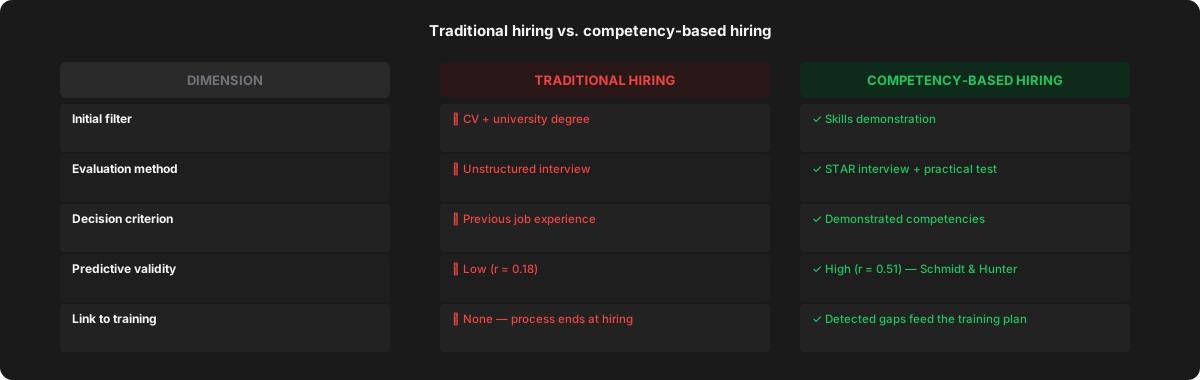
The practical difference with traditional hiring:
| Traditional selection | Competency-based hiring | |
|---|---|---|
| Initial filter | CV: degree, previous employer, years of experience | Job competency map |
| Evaluation method | Unstructured interview, personal impression | Behavioural interviews + practical tests |
| Decision criterion | Interviewer intuition | Data: scorecards with observable criteria |
| What it predicts | What the candidate has done (past) | What the candidate can do (present and potential) |
| Link to training | None | Detected gaps feed the training plan |
Terminology you will encounter
In HR in Spain, these are the terms you need to know:
| English term | Spanish equivalent | Common use |
|---|---|---|
| Skills-based hiring | Contratación basada en competencias | General model name |
| Competency framework | Mapa de competencias / perfil competencial | Base document for the process |
| Skills assessment | Evaluación de competencias | Measurement phase in hiring |
| Skills inventory | Inventario de competencias | Diagnosis of the current team |
This is not a new concept. What is new is the evidence that it works considerably better than the traditional method, and that most companies claiming to do it are not actually doing it properly.
Competency map: how to build yours step by step →
Why competency-based hiring is urgent in Spain in 2025
This is not an HR trend. There are data points and legislation behind it, and that window is closing.
The number that matters: 78% of companies cannot find talent
According to ManpowerGroup Spain (Talent Shortage Study, 2024), Spain's talent mismatch sits at 78%, two points above the global average of 75%. In 2014 it was 3%.
This is not a supply problem. It is an evaluation problem. If you keep filtering by university degree and years of experience, you are discarding people who could perform well in the role. The market has changed; most companies' filters have not.
39% of current skills will change before 2030
The World Economic Forum puts it plainly in its Future of Jobs Report 2025: 39% of workers' core skills will change significantly or become irrelevant in the next five years. 63% of employers cite the skills gap as their main challenge.
This means a candidate's CV tells you what they knew how to do two or three years ago, not what they can do today, and not what they can learn tomorrow. If you select by CV, you are reading the past. If you select by skills, you are assessing the present and potential.
What the law says: Spanish Workers' Statute, Article 23
This rarely gets mentioned in hiring articles, but it matters. Article 23 of the Workers' Statute (RDL 2/2015) establishes vocational training as both a worker's right and a company obligation. Article 23.3 recognises the right to 20 paid hours of job-related training per year, accumulating up to 100 hours over five years.
Article 52(b) also allows objective dismissal for failure to adapt to reasonable technical changes in a role, provided the company has first offered a training course to facilitate the adaptation. The dismissal cannot take effect until at least two months after the change was introduced or the training concluded (whichever is later). In practice: if you cannot show you identified the gap, offered training and allowed time to adapt, an objective dismissal on these grounds will be very difficult to defend in a labour court.
This means you need to know what skills your team has and what they are missing. A competency-based hiring process gives you exactly that: a documented map of your people's skills. Most Spanish SMEs have no formal documentation of their workforce's competencies. Competency-based hiring fills that gap. Consult your labour advisor before acting in a specific case: the details depend on sector, collective agreement and procedural timelines.
The 5 steps to implement competency-based hiring in your company

This framework is designed for SMEs of 50 to 200 employees with HR teams of 1 to 3 people. You do not need a dedicated L&D department or a special budget. You need a method.
How long does it take? For a single hiring process:
| Step | Who is involved | Estimated time |
|---|---|---|
| 1. Define role competencies | HR + hiring manager | 2 to 3 hours (one meeting + prep) |
| 2. Design the assessment | HR | 2 to 3 hours (first time; reusable after) |
| 3. Scoring sheets | HR | 1 hour (reusable template) |
| 4. Identify team gaps | HR | 2 to 3 hours (results analysis) |
| 5. Connect to training/FUNDAE | HR + management | 2 hours |
| Total first time | ~10 to 12 HR hours | |
| From the second process onward | ~4 to 5 hours (templates and competencies ready) |
Most of the effort is in the first process. From the second one, you already have competencies defined, interview questions ready and scoring sheets set up. The cost drops by half.
Step 1: Define the role's competency map (not the ideal candidate)
The most common mistake is defining the "ideal candidate" in the abstract. "We're looking for someone proactive, team-oriented and results-driven." That is not a competency map. It is a wish list that describes 90% of CVs.
A real competency map starts from the role, not the candidate. Ask yourself:
- What specific tasks will this person execute in the first 6 months?
- What technical skills are essential for those tasks?
- What soft skills separate someone who performs well from someone who stands out?
- What skills can I teach internally, and which must the candidate bring from day one?
That last one matters most. If you can teach a skill through internal training (funded, for example, with your FUNDAE credit), you do not need it as an entry requirement. This opens up your candidate pool considerably and reduces the talent mismatch the data shows.
Concrete example: competency map for a Warehouse Coordinator
This is the kind of document you should have before posting the job. It is not an ideal candidate profile. It is what the role needs.
| Skill | Type | Required level | Can it be taught with FUNDAE? |
|---|---|---|---|
| WMS (warehouse management system) | Technical | 3 - Advanced | Yes, if starting from level 2 |
| Inbound/outbound planning | Technical | 3 - Advanced | Partially |
| Team management (5 to 10 people) | Soft | 2 - Independent | Yes |
| Operational incident resolution | Soft | 3 - Advanced | Difficult, needs hands-on experience |
| Basic data analysis (Excel, dashboards) | Technical | 2 - Independent | Yes |
How to read this table: a candidate arriving at level 2 in WMS and level 3 in incident resolution is a better bet than one at level 3 in WMS and level 1 in incidents. The first gap closes with a 40-hour course (funded through FUNDAE). The second gap requires months of floor experience that training cannot accelerate.
That distinction is what separates competency-based hiring from hiring by CV. The CV does not tell you what level each skill is at. The map does.
Competency map: how to build yours step by step →
Step 2: Design the assessment: behavioural interviews + practical tests
Once you know what skills you are looking for, you need a way to measure them. The two most effective methods for SMEs (by cost and reliability) are:
Structured behavioural interviews: instead of asking "would you say you are a good team player?", you ask: "Tell me about a specific situation where you had to resolve a conflict with a teammate. What did you do? What was the result?" The key is structure: same questions for every candidate, same evaluation criteria.
Practical tests: put the candidate to work on a real task from the role. If you are hiring a logistics manager, give them a scenario with a routing problem and ask them to solve it. If you are hiring someone for customer service, simulate a complaint. You want to observe skills in action, not hear how they describe them.
Example: behavioural questions for a Warehouse Coordinator
Following the Step 1 example, these questions evaluate the skills in the map, not general impressions:
- Operational incident resolution: "Tell me about a situation where you received an incorrect delivery from a supplier and had to serve the customer within 24 hours. What did you do? What alternatives did you consider? How did the customer respond?"
- Team management: "Describe a time when a team member was not meeting order preparation times. How did you spot it? What conversation did you have? What changed afterwards?"
- Adapting to technical change: "Have you had to learn a new warehouse management system or digital tool on the job? What was the process like? What difficulties did you run into?"
None of these questions can be answered with a university degree. They are answered with real experience. The candidate without a degree who has managed a 15-person warehouse for three years will give much stronger answers than a recently graduated engineer who has never set foot on a warehouse floor.
You do not need expensive tools. A well-designed form and an evaluation rubric are enough to start tomorrow.
Step 3: Apply scoring sheets with measurable criteria
This is where most processes break down. You run the interviews, collect impressions, and end up hiring the person who gave you the best gut feeling. That is not competency-based hiring. It is intuition-based selection with extra steps.
A scorecard is as simple as a table. Following the Warehouse Coordinator example, here is one for "Operational incident resolution":
| Score | What you observe in the interview or test |
|---|---|
| 1 | Does not describe any specific incident they resolved. Generic answers ("I do what I'm told"). |
| 2 | Describes an incident but does not explain what alternatives they considered. Solved the problem, but reactively, without anticipating consequences. |
| 3 | Describes the incident in detail, explains the options they weighed and why they chose one. The customer or process was covered. This is the minimum for this role. |
| 4 | All of the above, plus evidence of anticipating the problem or putting measures in place to prevent recurrence. Proactively communicated to team or customer. |
| 5 | Describes a system or protocol they created to handle this type of incident on an ongoing basis. Has trained others in its resolution. |
Build a table like this for each skill in the map. You do not need all five levels in every case: for a first evaluation, defining what a 1, a 3 and a 5 look like is enough for two interviewers to reach the same conclusion.
Each interviewer fills in their sheet independently before sharing impressions. This reduces group bias and gives you comparable data across candidates. If you give a candidate a 3 on "Incident resolution" and the warehouse manager gives them a 5, the conversation is no longer "I liked them more" or "I liked them less." It becomes: "Did they show evidence of anticipating problems and training others, or did they just handle what was put in front of them?" The behavioural descriptor is the arbiter.
Step 4: Identify gaps: what skills your current team is missing
This step turns competency-based hiring into something more than a recruitment process. When you evaluate candidates with a skills map, you inevitably see two things:
- The skills the selected candidate is missing (which you will need to develop)
- The skills you cannot find in the market (which you need to develop internally)
Both pieces of information are invaluable for your training plan. Not a gut feeling of "I think we need an Excel course." Concrete data: "in 8 out of 10 candidates for the analyst role, the data visualisation skill scores below 3."
But hiring only shows you gaps in candidates. What about your existing team?
This is where the skills map moves from a hiring tool to a management tool. The process is simpler than it sounds, because you have already done the hard work: the skills from Step 1 and the scorecard from Step 3 are the same. What changes is who fills them in.
How to assess your current team in practice:
- The direct manager fills in the scorecard for each person on their team, using the same behavioural descriptors as in hiring. If level 3 on "Incident resolution" means "explains alternatives and the customer was covered," it means the same for a candidate as for someone who has been in the role for three years.
- Optionally, the employee self-assesses first. Self-assessment alone is not reliable (people either overrate or underrate based on confidence), but combined with the manager's assessment it produces a useful conversation. Where they agree, you have solid data. Where they diverge, you have a conversation worth having.
- Communicate the purpose before you start. The line that works: "This is not to call anyone out. It is to decide where we invest the training budget we already have." If the message comes from the CEO or MD, not just HR, participation goes up. People cooperate when they understand the output is development, not performance review.
- The result is a gap matrix by person and skill. Those gaps feed directly into Step 5: your funded through FUNDAE training plan.
When to run it: once a year, ideally in the first quarter, synchronised with FUNDAE planning. The full process for a team of 80 to 120 people with a 2-person HR team takes 2 to 3 weeks (each manager spends 2 to 3 hours; each employee, 15 minutes on self-assessment).
What is a competency assessment? A complete guide for HR
Want to start measuring skills with objective data? Start with the ones changing fastest: AI skills. Skillia's free AI skills assessment takes under 25 minutes and gives you your level on the most in-demand AI competencies, plus a personalised development plan. That is exactly the kind of data that turns an intuition into an action plan. Assess your AI skills →
Competency map: how to build yours step by step →
Step 5: Connect gaps to your training plan (and your FUNDAE credit)
And this is the angle nobody is telling you about. But first, you need to know something about your training budget.
The angle nobody tells you: competency-based hiring + FUNDAE training credits
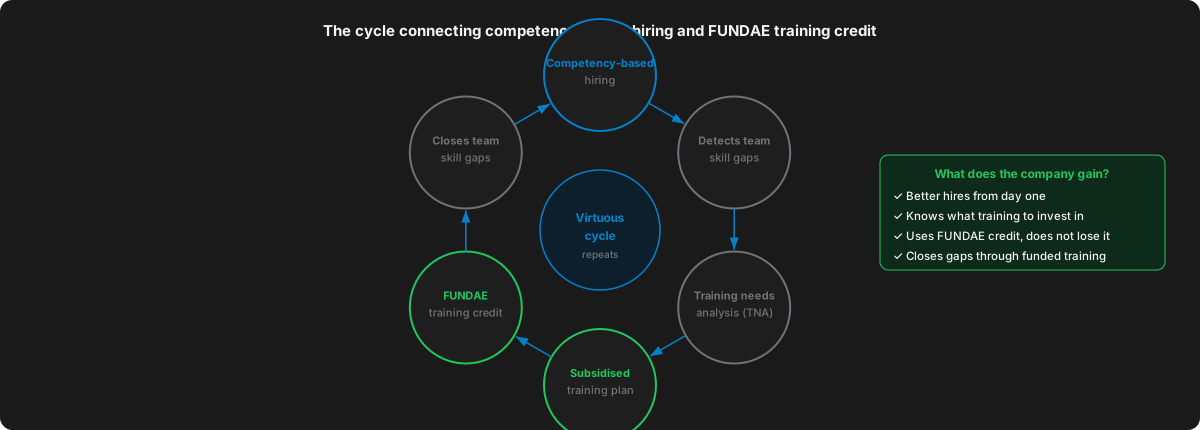
If your company has employees, you already have a training budget. It is called the FUNDAE subsidised training credit, and you fund it every month through approximately 0.6% of your Social Security contributions.
The problem is most SMEs do not use it. The FUNDAE/AENOA 2024 data is clear: of 1,697,759 potentially eligible companies, only 20.5% carried out planned training (FUNDAE/AENOA, Situation Report 2024). For micro-companies, the figure drops to 15.3%, compared to 91.8% for large companies.
80% of Spanish companies do not use their FUNDAE training credit. One of the most common reasons: they do not know what to spend it on. This is not a willpower or budget problem. It is a diagnosis problem. Without a skills inventory identifying real team gaps, choosing training becomes guesswork: "this year we'll do Excel and leadership."
How to connect competency-based hiring with FUNDAE
When you run a competency-based hiring process, you generate concrete data on what skills are missing, both in candidates and in your existing team. That data is exactly what you need to carry out a training needs analysis with a real foundation.
Instead of picking courses from a subsidised training catalogue at random, you can say: "Data from our last 5 hiring processes shows that data analysis consistently scores low. We are going to invest our FUNDAE credit there."
That is an evidence-based company training plan, not intuition. And it is exactly what FUNDAE requires to justify the subsidy.
The practical process
- Run the skills assessment of your team (Step 4 of the framework).
- Prioritise gaps by business impact and urgency.
- Find FUNDAE-accredited training that covers those specific gaps.
- Submit the training plan to the works council if your company has more than 50 employees (mandatory).
- Claim the subsidy through FUNDAE and recover the cost.
Competency-based hiring stops being just a recruitment process. It starts feeding your talent development strategy, funded by a budget you already have.
The 3 mistakes that kill competency-based hiring programs
Before you think changing the text of your job ads is enough, you need to understand why most competency-based hiring attempts fail. There is serious research on this.
Mistake 1: Cosmetic change: removing the degree requirement without changing the process
Joseph Fuller, a professor at Harvard Business School, and Matt Sigelman of the Burning Glass Institute published a 2024 study that should give pause. They looked at what happens when companies remove the university degree requirement from their job listings. The result: for every 100 job offers with the degree requirement removed, fewer than 4 additional candidates without a degree actually get hired (Harvard Business Review, Fuller and Sigelman, 2024).
Read that again. Fewer than 4 in 100.
Why? Because companies remove the degree requirement from the listing but change nothing else. Hiring managers keep filtering by university. Interviews stay unstructured. The credential bias keeps operating.
45% of companies say they plan to do more competency-based hiring but have made no real changes to their processes (HBR, Fuller and Sigelman, 2024). As Fuller explains: "Without proven assessment tools, hiring managers keep using the degree as a filter out of convenience, despite policy changes."
The lesson is plain: if you are going to do competency-based hiring, removing "University degree required" from the ad is not enough. You have to change how you evaluate, how you score and how you decide.
Mistake 2: Not defining skills precisely before posting the job
The second mistake is starting a hiring process without knowing what skills you are looking for. "Proactive person with leadership ability" is not a measurable skill. It is a wish.
Measurable skills sound like this:
- "Ability to manage 3 simultaneous projects with overlapping deadlines" (you can simulate this in a test)
- "Excel proficiency up to pivot tables and VLOOKUP" (you can assess this with a practical exercise)
- "Ability to communicate technical information to non-technical stakeholders" (you can observe this in a behavioural interview)
If you do not define skills at this level of specificity before posting the job, you will evaluate by gut feeling. And gut feeling has a terrible track record as a selection tool.
Mistake 3: Not involving hiring managers in competency evaluation
The third mistake is HR designing a perfect competency evaluation process, then the hiring manager running the final interview their own way: "Tell me about yourself. Why do you want to work here? Where do you see yourself in five years?"
And more concerning: 18% of companies that initially make progress with competency-based hiring later regress. Over time they end up hiring the same way as before, or worse (Harvard Business Review / Burning Glass Institute, 2024). According to the Harvard research, this happens precisely when hiring managers are not trained in and committed to the new process.
The solution is not to exclude the hiring manager. It is to include them from the start: they participate in defining role skills, use the same scorecard, understand why the process works the way it does. If they feel it is their process, they will respect it. If they feel it is something HR is imposing, they will undermine it.
The numbers that justify the change
If you need arguments to convince management (or yourself) that changing your hiring process is worth it, here are the most substantiated data points:
5 times more predictive: the most cited research in organisational psychology (Schmidt & Hunter, 1998, meta-analysis published in Psychological Bulletin) showed that skills tests are 5 times more predictive of job performance than academic qualifications, and more than twice as effective as prior work experience. McKinsey and other consultancies have popularised this finding in their talent strategy reports, but the underlying evidence has nearly three decades of replication and remains the reference standard in selection backed by evidence.
79% more likely to have a positive employee experience: according to Deloitte's Skills-Based Organization survey (2024), organisations that have adopted a competency-based model systematically are 79% more likely to provide a positive employee experience and 63% more likely to achieve strong results. Note: this data comes from a professional survey, not an experimental study with a control group. The correlation is clear, but causation is not established.
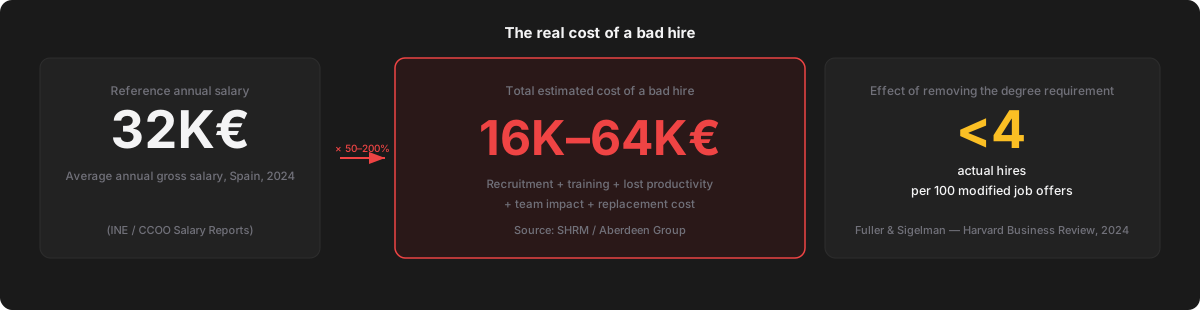
The hiring mistake cost you can calculate: according to Gallup (2019) and the U.S. Department of Labor, the cost of replacing an employee ranges from 50% to 200% of their annual salary, depending on seniority. In a Spanish SME, a hiring mistake on a technical profile earning 32,000 euros means 16,000 to 64,000 euros lost in failed recruitment, wasted onboarding, team productivity loss and a new process. If competency-based hiring prevents one bad hire per year, the return covers the effort many times over.
Fewer than 4 actual hires per 100 modified offers: the Harvard data (Fuller and Sigelman, 2024) has already come up, but it bears repeating as an argument for management. Cosmetic change does not work. You need to change the whole process. The good news: doing it properly costs time, not money.
The data is clear: hiring by skills works better than hiring by CV. The problem was never the evidence. The problem is that changing a hiring process requires method, discipline and the full decision chain playing by the same rules.
In summary
Competency-based hiring is not an HR trend. It is a change of method backed by evidence. But it only works if done properly: defining concrete skills, evaluating with method and scoring with data.
And if you are in a Spanish SME, you have an advantage you are probably not using: your FUNDAE credit. Competency-based hiring gives you the exact map of skills your team is missing. FUNDAE gives you the budget to close them. The connection between the two is the piece most companies miss.
The first step is knowing where you stand. Skillia's free AI skills assessment takes under 25 minutes and gives you your level on the most in-demand AI competencies, plus a personalised development plan. Assess your AI skills →
Already know you need a solution for your team? Talk to us →
References
- [1] ManpowerGroup Spain (2024). 2024 Talent Shortage Study. ↗ Fuente
- [2] World Economic Forum (2025). The Future of Jobs Report 2025. ↗ Fuente
- [3] Schmidt, F.L. & Hunter, J.E. (1998). The validity and utility of selection methods in personnel psychology. Psychological Bulletin, 124(2), 262-274. Reference meta-analysis on the predictive validity of selection methods. Popularised by McKinsey and other consultancies in talent strategy reports.
- [4] Harvard Business Review / Fuller, J. & Sigelman, M. (2024). Skills-Based Hiring Is on the Rise. ↗ Fuente
- [5] Deloitte (2024). Skills-Based Organization Report. (Professional survey data; correlation, not an experimental study with a control group)
- [6] Gallup (2019). This Fixable Problem Costs U.S. Businesses $1 Trillion. ↗ Fuente
- [7] FUNDAE / AENOA (2024). Balance de Situación de la Formación Programada 2024.
- [8] BOE (2015). Real Decreto Legislativo 2/2015, de 23 de octubre, Estatuto de los Trabajadores, Art. 23.3 y 52.b. ↗ Fuente
Frequently Asked Questions
What is competency-based hiring and how does it differ from traditional selection?
Competency-based hiring is a selection model that evaluates candidates on their demonstrated skills, not their degree or prior experience. Unlike traditional selection, which uses the CV as the main filter, this model uses a role competency map, structured behavioural interviews and practical tests to measure whether the candidate can do what the role requires.
Does competency-based hiring work for SMEs or only for large companies?
It works very well for SMEs. In a company of 80 people, a hiring mistake is far more visible than in one of 8,000. You do not need expensive software or a dedicated L&D department. You need a role competency map, a structured interview and a scoring sheet. You can build this with a shared document and discipline.
What skills should I evaluate in a competency-based hiring process?
It depends on the role; there is no universal list. What works is splitting them into two blocks: technical skills (role-specific: Python programming, payroll management, SAP) and soft skills (applicable across roles: problem-solving, communication, time management). Define the essential technical skills first, then the soft skills that differentiate a good professional in that specific role.
How do you assess soft skills in an interview?
With structured behavioural interviews using the STAR method (Situation, Task, Action, Result). Instead of asking "are you a good communicator?", you ask: "Describe a situation where you had to explain something technical to someone with no background in it. How did you do it? What was the result?" Each evaluator scores independently using a predefined scorecard, which reduces subjective bias.
Can I use competency assessment for my FUNDAE training plan?
Yes, and it is one of the best ways to use it. The skill gaps you detect in hiring processes tell you exactly what training your team needs. That data feeds your training needs analysis (TNA), which is the base document for justifying your subsidised training plan with FUNDAE. Instead of picking courses at random, you invest the credit in the skills you genuinely need.
Why do most competency-based hiring implementations fail?
According to Harvard Business Review (Fuller and Sigelman, 2024), most implementations fail because they are cosmetic: companies remove the degree requirement from job ads but change nothing else in the process. For every 100 offers that drop the degree requirement, fewer than 4 additional degree-free candidates are actually hired. Real change requires a competency map, structured assessment tools and the buy-in of hiring managers.
How much does it cost to implement competency-based hiring in an SME?
The main cost is time, not money. Building a role competency map, designing behavioural interviews and creating scoring sheets can be done internally by your HR team. In Spain, the training needed to implement this model can be funded through the FUNDAE subsidised training credit that every company with employees is entitled to by law.
What is the connection between competency-based hiring and FUNDAE credit?
They are directly connected. The competency-based hiring process generates an inventory of your team's skill gaps, which translates into concrete training needs. Those needs are the foundation for planning your FUNDAE-subsidised training. According to FUNDAE data (2024), only 20.5% of eligible Spanish companies use their credit, mainly because they do not know what to invest it in. Competency-based hiring solves that problem.
What tools exist to assess skills in hiring?
From the simplest (a spreadsheet with the competency map and scoring sheets) to specialised platforms that automate assessment and generate a team competency map. The key is not the tool; it is the discipline of the process. When you start to scale (more than 10 to 15 hiring processes per year), having a tool that centralises the data saves time and gives you aggregated insights you cannot get from Excel.
Related articles
Agile learning in the workplace
How to plan training and make the most of your FUNDAE credit using agile learning cycles. A practical guide with 4 principles and a quarterly sprint plan for Spanish SMEs.
Jordi Catafal
FUNDAE subsidised training in Spain
Complete guide to Spain's FUNDAE subsidised training system for 2026: real legislation, credit calculation, step-by-step process and mistakes to avoid. For HR managers who want to stop losing money.
Jordi Catafal
How to conduct a training needs analysis: a step-by-step guide for HR teams
A step-by-step guide to conducting a training needs analysis that produces reliable results: from identifying strategic competency gaps to building a continuous measurement practice.
Jordi Catafal