Competency map

"Yeah, we have something... let me look... I think the consultants did it when we got our ISO."
That line, or some version of it, comes up in six out of ten conversations I have with HR managers at Spanish SMEs when I ask what competencies they have mapped. What they find, if they find anything, is usually a Word document or an Excel spreadsheet from three years ago in a SharePoint folder nobody opens. The listed "competencies" are generic labels (leadership, teamwork, customer focus) with no levels, no observable indicators, no connection to any real assessment.
Another 25-30% start from absolute zero. The CEO says: "I know my people, I know who performs and who doesn't." No document, no data. All knowledge about the team's capabilities lives in one or two people's heads. That's a real operational risk: if that person leaves tomorrow, they take all the knowledge about what each team member can actually do.
Only 5-10% have something functional: an Excel matrix with levels, maintained by a dedicated HR department. But even those companies say the same thing: "It takes a lot of effort to maintain and nobody actually uses it."
The underlying pattern is clear: Spanish SMEs don't deny that competencies matter. What they've never had is a tool that makes managing them feasible without a disproportionate effort for their size.
This article is written from inside that problem. We'll look at how to build a competency map that actually works, the mistakes that make most of them end up in a drawer, and how to connect it with your subsidised training plan so your FUNDAE credit stops being money you leave on the table.
What a competency map is (and what it isn't)
A practical definition for SMEs
A competency map is a structured representation of the skills, knowledge and behaviours each role in your organisation needs. Its core purpose is to make visible the distance between what your team knows how to do today and what it needs to know how to do to meet business goals. In Spain, this concept is also known as "perfil competencial" or "marco de competencias", and it's the foundation of any well-grounded training plan.
It's not an academic document or a six-month project with external consultants. It's an operational tool that answers one concrete question: do we have the right people with the right skills in the right roles?
If the answer is "I don't know", you already have a problem. If the answer is "I think so, but I have no data", you have the same problem with more risk attached.
For an SME of 50 to 200 employees, the competency map doesn't need to be sophisticated. It needs to be useful. That means it should tell you three things:
- What competencies each role needs to meet business objectives.
- What level each person is at in those competencies today.
- Where the gaps are that require action, whether training, hiring or reorganisation.
Competency map vs. job description vs. competency profile
This causes a lot of confusion, so let's simplify:
| Concept | What it describes | What it's used for | Update frequency |
|---|---|---|---|
| Job description | Tasks and responsibilities of the role | Hiring and org chart | When the role changes |
| Competency profile | Specific skills required for a specific role | Selection and individual assessment | Annually |
| Competency map | Competencies across the whole organisation, by role and level | Training planning, gap detection, strategic decisions | Every 6 months |
The key difference: the job description tells you what someone does; the competency profile tells you what they should know how to do; the competency map gives you the full picture: it crosses all profiles, compares what you need with what you have, and shows you where the gaps are.
Think of the job description as the contract, the competency profile as the ingredient list, and the competency map as the full recipe for the team your business needs to function.
Example: what a real competency map looks like
To make this concrete, here's a simplified fragment of what a competency map might look like for a logistics company with 80 employees. The numbers represent the required level for each role (1 = Basic, 2 = Independent, 3 = Advanced, 4 = Expert):
| Competency | Type | Warehouse Manager | Sales Rep | Production Technician |
|---|---|---|---|---|
| WMS management | Technical | 4 | 1 | 2 |
| Basic data analysis | Technical | 3 | 2 | 2 |
| Commercial negotiation | Technical | 1 | 4 | 1 |
| CRM management | Technical | 1 | 3 | 1 |
| Production planning | Technical | 2 | 1 | 4 |
| Adapting to tech change | Cross-functional | 3 | 2 | 3 |
| Effective communication | Cross-functional | 3 | 4 | 2 |
| Teamwork | Cross-functional | 3 | 2 | 3 |
Notice three things: each role has a different profile (not the same levels for everyone), the competencies mix technical and cross-functional, and required levels vary based on how critical that competency is for that specific role. The sales rep doesn't need to be an expert in WMS; the warehouse manager doesn't need to master commercial negotiation. The map reflects that reality instead of demanding the same from everyone.
When you assess each person and compare their actual level to the required level, the gaps appear. That's where the real work begins.
Why your company needs a competency map in 2026
Quick self-assessment: 5 questions for your leadership team
Before reading on, answer these five questions with yes or no:
- Do you know how long it takes a new employee to reach expected performance levels in each role?
- Do you have documented, shared criteria for deciding who to promote?
- If your key person in operations, sales or production left tomorrow, would you know exactly what competencies you need to replace?
- Does your annual training plan respond to identified gaps, or is it chosen from a catalogue?
- Do you use more than 50% of your FUNDAE training credit each year?
If you answered "no" to 3 or more questions, you have a visibility problem around your team's competencies that's costing you money. Read on to understand how much, and how to fix it.
8 in 10 SMEs can't find the talent they need
According to ManpowerGroup Spain's talent shortage study (2025), 80% of mid-sized Spanish companies (50-249 employees) report difficulty filling vacancies due to a lack of suitable profiles.
This shouldn't surprise anyone working in HR at an SME. You live it daily: you post a job, get a hundred applications, and none of them fit. Or worse: you hire someone who looks right on paper but is missing competencies you never properly defined.
The problem isn't just in hiring. According to the World Economic Forum (Future of Jobs Report, 2025), 63% of employers identify the skills gap as the biggest barrier to their business transformation. And 39% of key skills are expected to change by 2030. If you don't know what competencies you have today, how are you going to plan for what you'll need tomorrow?

There's a data point that puts the scale of the problem in perspective. The BBVA Foundation, in a study based on PIAAC-2023 from the OECD (Esenciales 5/2025), revealed that the basic skills gap (literacy, numeracy) of young Spaniards (25-34) compared to the OECD average has tripled relative to the previous generation (55-65). As the study, authored by Lorenzo Serrano (Universitat de València / Ivie), concludes: "The entire increase in the gap can be attributed to the quality of education." While this data refers to the education system rather than directly to SME competency management, the practical implication is clear: you can't assume competencies from a degree. A qualification no longer guarantees a level. If you want to know what your people can do, you have to measure it.
According to Deloitte (2025 Global Human Capital Trends), 74% of workers, managers and executives consider prioritising human capabilities to be very important or critically important. Investment in competencies is no longer just an HR initiative, it's a shared priority across the whole organisation.
The real cost of not having a map: numbers your CEO should see
Macro data is useful for context, but what drives decisions in an SME is euros and weeks. Let's run the numbers on a typical case.
A company of 100 employees with an average salary of €28,000 pays approximately 0.6% of its payroll as the employer contribution to vocational training (Orden PJC/178/2025, BOE). That's roughly €16,800 per year in VT contributions. For a company in the 50-249 employee band, the FUNDAE credit is 60% of that contribution: around €10,000 of available credit per year.
According to FUNDAE's activity reports, most SMEs, especially smaller ones, don't use up their credit. Industry estimates put underutilisation at between 70% and 85% depending on the band and the year. If your 100-employee company leaves 75% of its ~€10,000 credit unused each year, that's over €7,000 evaporated annually, money you already paid that doesn't come back.
But the FUNDAE credit is just the tip of the iceberg. According to Gallup (2019), the cost of replacing an employee ranges from 50% to 200% of their annual salary, depending on the level of the role. The U.S. Department of Labor puts the conservative estimate at at least 30% of first-year salary. Take a middle scenario: a technical profile at €32,000 with a 50% replacement cost means €16,000 lost in recruitment, onboarding, lost productivity and team morale. If a competency map helps you define what you need more precisely and avoid one bad hire per year, the return more than covers the effort.
The question for your CEO isn't "how much does building a competency map cost?" but "how much is not having one costing us?"
Executive summary: the cost of inaction
Item Estimated annual cost Unused FUNDAE credit (75% of ~€10,000) ~€7,500 One avoidable bad hire (50% of €32,000) ~€16,000 Annual cost of not having a map ~€23,500 Cost of building the map (35-45 h of HR × ~€20/h) ~€700-900 Conservative figures for a 100-employee company, 50-249 FUNDAE band, one bad hire per year. The return multiplies with every better-informed decision.
Competency map + FUNDAE: the connection most companies miss
Here's the angle most articles about competency maps ignore, and for a Spanish SME it's probably the most relevant point.
The FUNDAE credit varies by company size. FUNDAE (Fundación Estatal para la Formación en el Empleo) is Spain's national body that manages subsidised workplace training. These are the credit percentages on the employer VT contribution (subject to annual revision in the State Budget):
| Average headcount | FUNDAE credit | Required co-financing |
|---|---|---|
| 1-9 employees | 100% of contribution (minimum guaranteed €420) | 1-5: exempt; 6-9: 5% |
| 10-49 employees | 75% of contribution | 10% |
| 50-249 employees | 60% of contribution | 20% |
| 250+ employees | 50% of contribution | 40% |
Source: Credit percentages are set by Ley 30/2015 and RD 694/2017. The VT contribution rate (currently 0.6% employer-side) may change via annual ministerial order (2025: Orden PJC/178/2025). Co-financing can be covered by the employee's salary cost during training hours, provided training takes place during working hours and is documented as such.
The reality is that most SMEs underuse that credit. The typical scenario: your advisor calls in September saying you have X euros left to spend before December. Courses are chosen from a catalogue, not from a diagnosis of needs. It becomes a "spend" to justify, not a strategic investment.
The disconnect is total. The usual question is "What courses can we subsidise?", when it should be "What gaps do we have and what training closes them?"
FUNDAE, as a system, incentivises spending the credit, not investing it well. It doesn't ask you to demonstrate competency impact. So there's no external incentive to connect the two. The connection only happens when there's internal maturity in people management.
The competency map is exactly that bridge. When you know what gaps your team has, you can design a company training plan that:
- Invests FUNDAE credit in the training that actually closes gaps.
- Justifies every euro to leadership and to workers' legal representatives.
- Connects training needs identification with measurable business results.
Companies that make this connection, about 10-15%, get better ROI from the credit, clearer justification for leadership, and higher employee engagement, because the training makes sense to them rather than feeling like "a course I was put on".
How to build a competency map in 5 steps
Let's get practical. These five steps are designed for an SME with a small HR team, no external consultants, no six-month projects, no expensive software. What you need is a clear method and the will to do it properly.
Overview of the 5 steps to build your competency map
- Define the business-critical competencies (not the ideal ones)
- Assess your team's current level
- Identify priority gaps
- Connect gaps to your training plan (and your FUNDAE credit)
- Review and update every 6 months
How long does this take? For an SME of 80-150 employees with 10-15 job families:
| Phase | Who's involved | Estimated hours |
|---|---|---|
| Step 1: Define competencies | HR + Leadership + 3-4 managers | 6-8 h (2h session + preparation + validation) |
| Step 2: Assess current level | HR coordinates; each manager 2-3 h; each employee 15 min | 15-20 h for HR |
| Step 3: Identify gaps | HR | 4-6 h |
| Step 4: Connect to training and FUNDAE | HR + Leadership | 6-8 h |
| Step 5 (recurring): Half-yearly review | HR + Leadership | 3-4 h every 6 months |
| Total Leadership/CEO time | Initial session + plan validation + review | ~4 h |
Total first time: ~35-45 hours of HR work, spread over 4-6 weeks, plus 2-3 hours per manager and 15 minutes per employee. For a 2-person HR team, this is manageable without stopping everything else. The CEO or director needs to be present for roughly 4 hours total (the initial priorities session and the training plan validation). From the second cycle onwards, the half-yearly review drops to under 10 hours.
Step 1. Define the business-critical competencies (not the ideal ones)
The first step doesn't start in HR. It starts with a conversation with leadership: what are the business priorities for the next 12-18 months? Growing into a new market? Digitalising a process? Improving customer service? Reducing dependence on a key person?
From there, translate those priorities into concrete competencies. Not the ideal ones. The critical ones. The ones that, if you don't have them, the business can't move forward.
How to do it:
- Get leadership and area managers in the same room. Run a 2-hour session around one question: "What do we need to know how to do as a company to reach our goals?"
- Separate technical competencies from cross-functional ones. Technical skills are specific to each area (SAP proficiency, contract negotiation, project management). Cross-functional skills are shared across the organisation (communication, leadership, results orientation).
- Prioritise ruthlessly. If you end up with more than 12 core competencies, you're including nice-to-haves. Cut until only the ones that directly affect business results remain.
- Validate with managers and with people actually doing the roles. Present the draft list to 3-4 team leads and 2-3 role holders. Managers know what they need from their team; the people in the roles know what they actually do day-to-day. Both matter.
Practical example: A logistics company with 80 employees in Barcelona. Their priority for 2026 is to automate warehouse management. The critical competencies aren't "transformational leadership" or "strategic thinking". They are: WMS management (warehouse management system), basic data analysis, and the ability to adapt to technological change.
Important: define levels with observable behaviours, not empty labels. This is the difference between a map that works and a decorative one. For each competency, describe what you actually see in practice at each level. Example with "Adapting to technological change":
| Level | What you observe in practice |
|---|---|
| 1 — Basic | Follows instructions to use new tools with direct supervision. Needs frequent support when processes change. |
| 2 — Independent | Adopts new tools independently after initial training. Adapts to process changes without supervision. |
| 3 — Advanced | Identifies improvement opportunities using technology. Trains colleagues on new tools. Proposes changes. |
| 4 — Expert | Leads the implementation of technology changes in their area. Evaluates and selects new tools. Designs processes. |
When two managers assess someone using these descriptors, they reach the same conclusion. When they use a generic 1-to-5 scale without descriptors, each interprets it differently.
Remember the rule: 10-12 core competencies per job family (HRSG; CIPD). More than that and the map becomes an unmanageable catalogue.
Output: A list of 10-12 core competencies with levels defined by observable behaviours, aligned with current business strategy.
Step 2. Assess your team's current level
Once you're clear on what competencies you need, it's time to find out where your people are. There are several options, from simplest to most sophisticated:
Self-assessment paired with a direct manager review is the quickest and cheapest option. The employee reads the behavioural descriptors, picks their level, the manager adjusts, and you have a starting point. It's not perfect, but it's enough to get going.
A 360-degree assessment is more complete, since it pulls in peers and collaborators, but it needs more time and a team where feedback is already a normal part of how things work.
Competency tests, whether practical exercises or simulations, measure what someone can actually do rather than what they say they can do. AI-powered assessment platforms take this further by automating the whole process, giving you structured data instead of scattered opinions in a spreadsheet.
For an SME starting from scratch, the recommendation is to begin with self-assessment + manager using the behavioural descriptors from Step 1. The employee reads the four levels for each competency and assigns the one that best describes their current reality. The manager reviews and adjusts. If there's disagreement, a 10-minute conversation usually resolves it: the behavioural descriptor is the arbiter.
A note on internal communication: before launching the assessment, explain to the team why you're doing it and what you'll do with the results. The biggest blocker I see in SMEs isn't the methodology, it's employees fearing they're "being tested" and managers fearing the data will be used against them. Be transparent: "This is to identify where to invest in training, not to single anyone out." Having the CEO or general director communicate this, not just HR, reinforces the message.
If two managers assess the same person at different levels, run a brief calibration session: sit them down to discuss the behavioural descriptor and the specific case. It's not a science, but it prevents the same person being "level 2" for one manager and "level 4" for another.
Output: A matrix showing the actual competency level of your team.
Want to see what a competency assessment looks like with objective data? Start with the competency that's changing fastest: AI. Skillia's free AI competency assessment takes under 25 minutes and gives you your level across the most in-demand AI competencies, plus a personalised development plan. It's exactly the kind of data your map needs to move from "estimated level" to "measured level". [Assess your AI competencies →]
What is a competency assessment? A practical guide for HR
Step 3. Identify priority gaps
This is where the map comes to life. When you cross "what we need" with "what we have", the gaps appear. And not all gaps are equal.
Classify them into three levels:
- Critical: competencies you need now that directly impact business objectives. Immediate action.
- Important: gaps that affect performance but don't block the business today. Training plan within 6 months.
- Desirable: areas for improvement that can wait. Review in the next cycle.
Practical tip: Visualise gaps in a 2x2 matrix (business impact × gap size). The ones in the "high impact / large gap" quadrant are where you should concentrate your training investment.
Back to our Barcelona logistics company: after assessing the team, they discover the Warehouse Manager is at level 2 in "WMS management" (needs a 4) and level 1 in "Basic data analysis" (needs a 3). Two of the three sales reps are at level 2 in "Commercial negotiation" (need a 4). The WMS gap is critical because warehouse automation is the year's top priority. The negotiation gap is important but doesn't block the business today. That distinction is what separates smart training investment from spreading training equally across everything.
Output: A prioritised list of competency gaps with clear business impact.
Step 4. Connect gaps to your training plan (and your FUNDAE credit)
This is the step that turns the map from a theoretical exercise into a real management tool. And it's the step most guides don't explain.

You have your gaps identified and prioritised. Now, for each critical gap, define:
- Decide what training closes the gap: a course, internal mentoring, a certification, a practical project. Be specific: "Agile project management course, intermediate to advanced level" is much better than "training in projects". Keep in mind that not all training is subsidisable through FUNDAE: training must be related to the company's activity and professional competencies. Very generic content, personal development training without a clear occupational link, or courses for directors without staff may face scrutiny in an audit.
- Name who needs it. Specific individuals, not "the whole department".
- Work out the cost and how much you recover. Verify your available FUNDAE credit directly in the FUNDAE management application (don't rely on a manual estimate alone, since the final credit is validated by FUNDAE and may differ if there have been contribution adjustments). Remember the private co-financing obligation: for companies of 50-249 employees it's 20% of the subsidised cost. This co-financing can be covered by the employee's salary cost during training hours.
- Document the training needs identification (TNI). This internal document is your best tool for justifying training decisions to leadership and aligning the training plan with workers' legal representatives. Important: the TNI is not a formal requirement that FUNDAE audits directly. What FUNDAE checks in an audit is that training was carried out as communicated, that declared attendees actually attended (signed attendance records), that the provider was eligible, and that the subsidies applied correspond to real, properly documented training (invoices, materials). The TNI is internal backing, not a shield against FUNDAE.
On workers' legal representatives (WLR): if your company has constituted legal representation, a Works Council (from 50 employees) or Staff Delegates (from 10 employees), you have a legal obligation to inform the WLR about the training plan. Under Ley 30/2015 and RD 694/2017, the WLR must not only be informed but, depending on your collective agreement, may have the right to participate in drafting the plan. "Informing" and "negotiating" are distinct processes with different legal implications. Check your collective agreement before considering the plan finalised. This is not a minor detail: a training plan that hasn't gone through the correct information/consultation process with the WLR can generate labour disputes that block the whole initiative.
Back to the logistics company: the Warehouse Manager's critical WMS gap (level 2 → needs 4) translates into a concrete training action: "Advanced warehouse management with SAP EWM course, 40 hours, blended mode". Cost: €1,200. Estimated FUNDAE subsidy (verified in the application): ~€720. Net cost to the company after subsidy: ~€480, plus co-financing covered by the employee's salary cost during training hours. The two sales reps with a negotiation gap are enrolled in a 20-hour major accounts negotiation programme (€600 per person, ~€360 subsidisable each). Total plan: €2,400, of which ~€1,440 is recovered via FUNDAE. Without the map, those €1,440 would have ended up in a generic "communication skills" course that closes no real gap.
Two FUNDAE operational details most companies get wrong:
- Start notification: through FUNDAE's online system, this must be done before training begins (art. 15, RD 694/2017). The minimum notice period is set by FUNDAE each year and has varied between 2 and 7 calendar days: check the current deadline in the FUNDAE application itself before scheduling training. If you don't notify in time, the subsidy is void. This is the most common operational error and the one that costs the most money. You must also notify the completion of the training action within the deadline set by the application.
- Document retention: keep all supporting documentation (attendance records, invoices, materials, connection logs if e-learning) for at least 4 years. That's the applicable statute of limitations. If FUNDAE or the Labour Inspectorate requests documentation and you don't have it, reimbursement is automatic.
Output: A training plan tied to real gaps and financed (in the subsidisable portion) with your FUNDAE credit.
Step 5. Review and update every 6 months
A competency map that isn't updated is a map that lies. Traditional competency models fail precisely because they go stale before they're even published, as Degreed (2024), specialists in competency management platforms, have noted.
The half-yearly review doesn't need to be a project. It's a two-hour meeting where you:
- Check whether business priorities have changed (and adjust the critical competencies).
- Update the assessments of people who have received training (to measure whether the gap has closed).
- Add new competencies that the market or technology is demanding.
- Remove competencies that are no longer relevant.
Back to the logistics company: six months after the WMS course, they reassess the Warehouse Manager. They've moved from level 2 to level 3. Still not at the 4 they need, but the gap has halved. The next cycle's priority: a supervised practical project to consolidate level 4. Meanwhile, the company has decided to also digitalise route management, so they add a new technical competency ("Route optimisation with TMS software") that didn't exist in the first map. The map evolves with the business.
The competency map works like a living organism, not an annual report. The more you use it in training, hiring and promotion decisions, the more useful it becomes and the easier it is to keep current.
Output: A living competency map that evolves with the company, not a document gathering dust.
The 5 mistakes that turn your competency map into a wasted exercise
I've seen too many competency maps created with good intentions and ending up abandoned. These are the most common and most avoidable mistakes. If you've followed the 5 steps above, you'll have sidestepped many of them. But it's worth keeping them as a checklist of what NOT to do.
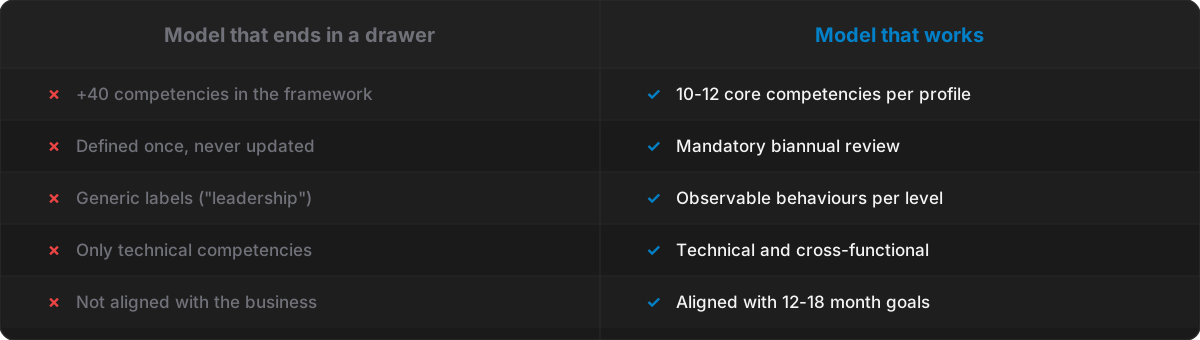
Error 1. Including too many competencies (the 10-12 rule)
It's the most widespread mistake. According to best practice guides from specialist consultancies like HRSG and CIPD, core competencies should be limited to 10-12 per job profile. When an organisation has more than 50 competencies in its framework, managers stop using it because it's too complex to apply to real day-to-day decisions.
For an SME of 80 or 150 employees, the temptation is to think "if we're doing this, let's do it properly" and end up with a 40-page document nobody consults. The reality is the opposite: the simpler it is, the more useful. Define the 10-12 competencies that truly matter for each job family and work with that.
The practical rule: if a manager can't remember the key competencies of their team without consulting a document, you have too many.
Error 2. Building it once and never updating it
Traditional competency models have a structural problem: they evolve so fast that they're often stale before they're even approved and published. If your competency map reflects 2023 needs, in 2026 it's a historical document, not a management tool.
This comes up constantly: roles that no longer exist are still in the map, while new roles (data, digital, automation profiles) don't appear anywhere.
The WEF tells us that 39% of key skills will change by 2030 (Future of Jobs Report, 2025). In that environment, a static map is a photo of a race that's already finished.
The solution isn't rebuilding the map every month, that's not feasible with a small HR team. But you do need a regular review mechanism. Every six months is a good starting point, as we saw in Step 5.
Error 3. Not aligning the map with business objectives
This is the silent enemy. People management initiatives that aren't connected to business objectives tend to lose priority, budget and leadership support. The competency map is no exception.
I've seen companies where HR builds a competency map based on what they think is important, without talking to leadership about business priorities for the next 12-24 months. The result: a technically correct map that's strategically irrelevant.
If your company is opening a new market next year, your competency map should reflect the skills you need for that opening. If you're digitalising operations, the missing digital competencies should appear. The map isn't an isolated HR exercise, it's a business tool.
The practical rule: before defining a single competency, get the general management and area leads in the same room. Ask: "What do we need to know how to do as a company in the next 18 months that we currently can't?" The competencies in the map should come from that answer.
Error 4. Focusing only on technical competencies
The Deloitte 2025 Global Human Capital Trends report is clear: 74% of workers, managers and executives consider prioritising human capabilities to be very important or critically important.
A competency map that only captures technical skills ("knows SAP", "masters Excel", "knows regulation X") is incomplete. Cross-functional competencies (communication, problem solving, adaptability, teamwork) are what make the difference between a team that works and one that doesn't.
This is especially relevant in SMEs, where versatility is the norm. Your administration manager probably also handles part of the supplier relationship. Your production lead likely manages a team without having received people management training. The map should reflect that reality.
The practical rule: your map should include both technical competencies (specific to each role) and cross-functional competencies (shared across the organisation). The balance varies by sector and level, in operational roles the technical tends to matter more; in management roles, the cross-functional, but what matters is that both are represented.
Error 5. Confusing personality traits with observable competencies
This is the error I see most often in companies that already have some kind of map when they start working with formal assessments. The map lists things like "Proactivity", "Leadership", "Results orientation", but without defining what specific behaviours evidence that competency at each level.
It's a wish list, not a measurement instrument.
The consequence: when the assessment comes, two managers interpret "leadership level 3" in completely different ways. One understands it means "manages team conflicts"; another, that it means "makes decisions without consulting". The map can't be used to compare, detect gaps or make decisions.
And there are associated errors that compound the problem: using the same 8 generic competencies for all roles (receptionist and operations director both assessed on "strategic vision"); scales from 1 to 5 without defining what each level means; copying a consultancy's template without adapting it to the business; assessing annually, filing the results, and nothing happening.
The meta-error behind all of this: the map was created as a compliance artefact, for the ISO, for the audit, to "have something", rather than as a management tool. When you ask "how do you use this day-to-day?", the answer is usually an uncomfortable silence.
From static map to living tool: how technology changes the rules
Why Excel falls short (and what alternatives exist)
Let's be realistic: most Spanish SMEs manage their competencies, if they manage them at all, in an Excel spreadsheet. And for getting started, that's fine. A well-designed Excel lets you have a first version of the competency map with no technology investment.
But Excel has clear limits:
- Scaling is painful. With 50 employees and 10 competencies per role, you're managing hundreds of cells that break every time someone copies a formula incorrectly.
- Every review is manual work that nobody has time for.
- Cross-referencing is a headache. Seeing an individual gap is possible; spotting patterns by department, by seniority or by level is another matter entirely.
- There's no connection to training. The jump from "this person has a gap in X" to "we're signing them up for this FUNDAE course" is done by hand, in a separate document.
For small HR teams that want to move to the next level, there are tools that automate competency assessment, cross-reference data and give you an updated map without having to rebuild it from scratch every time.
AI-powered assessment: beyond the annual snapshot
The natural evolution of the static competency map is a system that assesses competencies continuously, not once a year, but as part of the normal workflow.
AI-powered competency assessment tools make something previously unthinkable for an SME possible: having an up-to-date picture of your team's competencies without HR having to spend weeks collecting data manually. The system assesses, identifies gaps and suggests actions, from specific training to team reorganisation.
As Josh Bersin noted in an executive workshop on skills-based organisations (SeekOut, February 2024): "We're in the middle of a transformation from a job-based architecture to a people-based architecture." The most successful competency projects, according to Bersin, focus on three concrete problems: underperforming operations, clearly defined skills gaps, or long-term skills transformation.
The point isn't to replace human judgment. It's to give it reliable data to act on. Because making training decisions with intuition and a 2023 Excel spreadsheet isn't competency-based management, it's hope-based management.
Conclusion: the map as starting point, not destination
The competency map isn't an end in itself. It's the starting point for making better decisions about your people: what to train them in, who to hire, how to organise teams, and how to spend a training budget you already have by law.
If you're an HR manager in an SME and today you manage your team's competencies with intuition and an inherited Excel file, the first step isn't to buy software or hire consultants. It's to sit down with leadership, define the 10-12 competencies that truly matter, and assess where your people are. With that, you already have a map. Imperfect, but infinitely more useful than nothing.
Your team already has the talent. Your company already has the budget. What's missing is the map that connects the two.
Ready to assess your team's competencies? Tell us about your situation and we'll show you how it works in practice. Request a demo →
References
- [1] ManpowerGroup España (2025). Estudio de Escasez de Talento 2024-2025. ↗ Fuente
- [2] World Economic Forum (2025). The Future of Jobs Report 2025. ↗ Fuente
- [3] Deloitte (2025). 2025 Global Human Capital Trends Report. ↗ Fuente
- [4] Fundación BBVA / PIAAC-OCDE (2025). Esenciales 5/2025: Competencias básicas de los jóvenes españoles. Lorenzo Serrano, Universitat de València / Ivie.
- [5] FUNDAE (2025). Créditos de formación bonificada — tramos por tamaño de empresa. ↗ Fuente
- [6] Ley 30/2015, de 9 de septiembre, por la que se regula el Sistema de Formación Profesional para el empleo en el ámbito laboral. Real Decreto 694/2017.
- [7] Orden PJC/178/2025 (BOE). Cotización de Formación Profesional — tipos vigentes.
- [8] Gallup (2019). This Fixable Problem Costs U.S. Businesses $1 Trillion. ↗ Fuente
- [9] HRSG; CIPD. Competency Framework Design — Best Practices.
- [10] Josh Bersin (2024). Executive workshop on skills-based organisations. SeekOut, February 2024.
- [11] Degreed (2024). How the Half-Life of Skills Impacts Your Workforce.
Frequently Asked Questions
What exactly is a competency map?
A competency map identifies and organises the skills, knowledge and behaviours each role in an organisation needs, so you can make informed decisions about training, hiring and internal development.
How many competencies should a competency map include?
No more than 10-12 core competencies per job profile (HRSG; CIPD). More than 50 competencies in a framework reduces adoption because managers can't apply it to day-to-day decisions.
Who should be involved in building a competency map?
Three profiles: leadership (business objectives), HR (structure and process) and team managers (operational validation). Including role holders improves accuracy. In an SME, this might mean 4-5 meetings of 30 minutes each.
How often should a competency map be updated?
At least every 6 months. The WEF estimates that 39% of key skills will change by 2030. If there are significant business changes (new product line, restructuring, digitalisation), do an additional review.
Can a competency map be connected to FUNDAE training credits?
Yes. The map identifies training gaps; the FUNDAE credit funds the actions to close them. The credit varies by company size (from 50% to 100% of the VT contribution). Without a map, most companies spend that credit on generic courses.
What's the difference between a competency map and a competency matrix?
The map defines what competencies the organisation needs, at what level and for which roles. The matrix crosses employees with competencies and shows each person's current level. The map is the strategy; the matrix is the current-state snapshot.
Why do most competency maps fail?
Over-complexity (too many competencies), obsolescence (not updating it), lack of alignment with the business (generic competencies with no connection to real goals) and being created as a compliance artefact rather than as a management tool.
Can an SME without an L&D department build a competency map?
Yes. With an HR team of 1-3 people and the 5 steps in this guide, the total effort is around 35-45 hours spread over 4-6 weeks. You don't need an L&D department — you need a clear process.
Related articles
What Is Competency Assessment? A Practical Guide for HR Teams
Only 8% of organizations have reliable data on their workforce's competencies. This guide explains what competency assessment is, how it differs from performance evaluation, and how to launch one in 6–10 weeks without a consultancy.
Jordi Catafal
Agile learning in the workplace
How to plan training and make the most of your FUNDAE credit using agile learning cycles. A practical guide with 4 principles and a quarterly sprint plan for Spanish SMEs.
Jordi Catafal
Competency-based hiring: a practical guide to selecting candidates by what they can actually do
A 5-step framework for implementing competency-based hiring in SMEs, connected to the FUNDAE subsidised training credit. No academic theory. Practical method, evidence-backed data and ready-to-use scorecards.
Jordi Catafal